An 87-Point Shadow: #9 UTSA Opens American Conference Play at home Against Charlotte
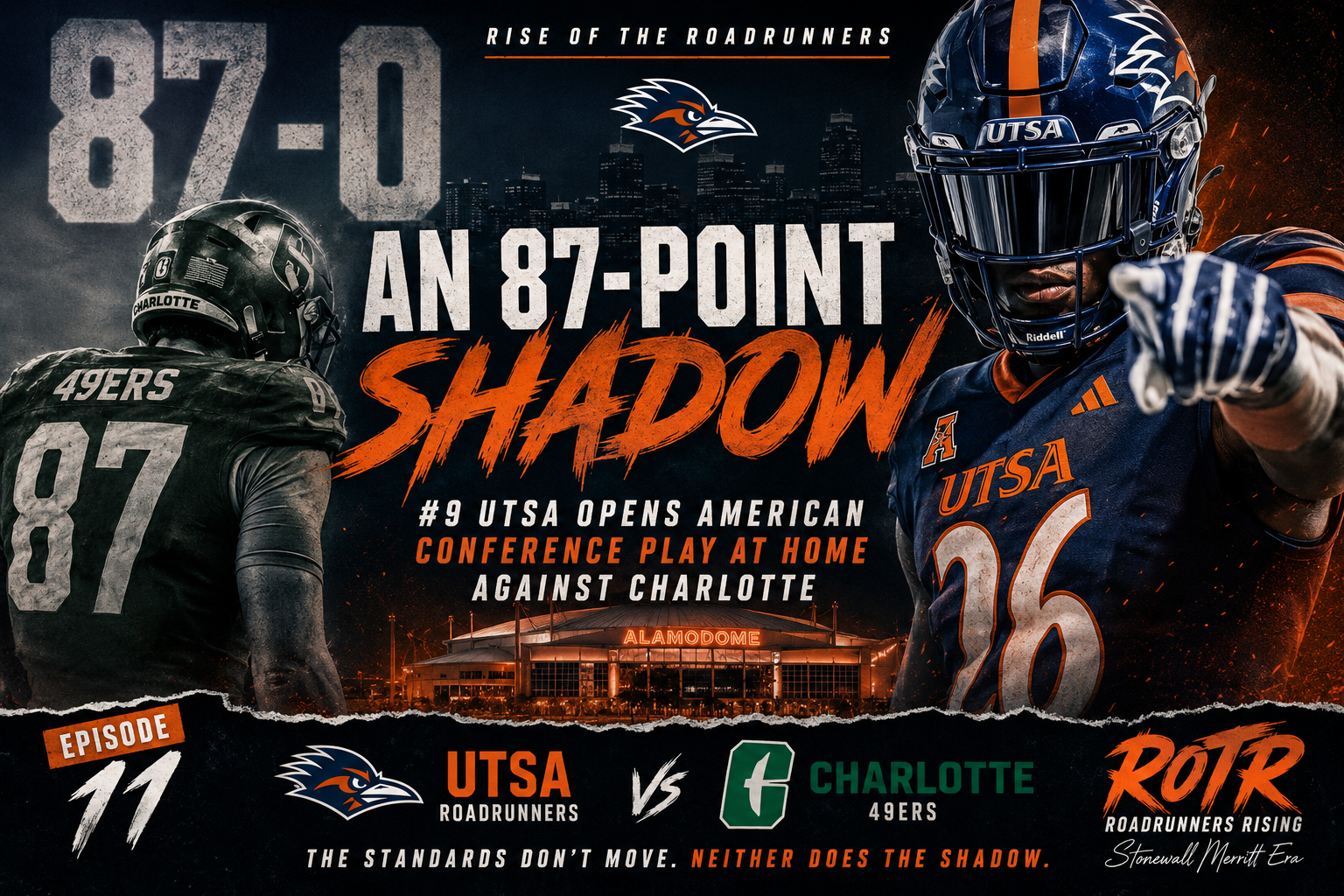
Eighty-seven points do not stay in the box score.
They travel.
They sit in the film room. They echo through winter workouts. They show up in the middle of spring practice when nobody says the number out loud, but everybody knows what it means. They follow a program into the offseason, into the next schedule release, into the next scouting report, and eventually into the next tunnel walk.
For Charlotte, that walk is coming.
This week, the 49ers are not just coming to San Antonio to open American Conference play against #9 UTSA.
They are walking into the Alamodome under an 87-point shadow.
Last season, Clay “Stonewall” Merritt and the Roadrunners went to Charlotte and turned a conference road game into a program-wide warning. UTSA did not simply win. UTSA erased the 49ers, 87-0, in a game that became less about the opponent and more about the machine Merritt was building in real time.
Now the matchup comes back around.
Different season.
Different setting.
Different version of Charlotte.
Same shadow.
The Number That Refuses to Leave
There are losses, and then there are games that become part of a program’s permanent record.
For Charlotte, last year’s meeting with UTSA was the second kind.
The final read 87-0. The Roadrunners outgained the 49ers 522 to 38 in offensive yards. Charlotte managed only four first downs. UTSA created points on offense, defense, and special teams until the game stopped feeling like competition and started feeling like evidence.
That was the night Charlotte learned the difference between preparing for a problem and preparing for a system.
The 49ers came in worried about Robert Henry Jr. They had reason to be. Henry had become the heartbeat of that first Merritt team, the sixth-year senior guard dog who could lean on a defense until the fourth quarter finally broke open.
So Charlotte loaded its eyes toward the run.
UTSA answered through the air.
Owen McCown saw it. David Amador II punished it. Devin McCuin worked the space. Houston Thomas stressed the middle. Willie McCoy flashed the kind of speed that made the depth chart feel unfair. Before Charlotte could settle into its plan, UTSA had already moved on to the next answer.
That was the first lesson.
The problem was not that Charlotte had no plan.
The problem was that UTSA had an answer for the plan before the plan could breathe.
Last Year Was Not a Blowout. It Was a Blueprint.
When people look back at that 87-0 score, the easy mistake is to treat it like a one-off. A weird night. A broken game. One of those College Football 26 avalanches where the scoreboard gets loose and never finds its way back.
That is not what happened.
That game was a blueprint.
UTSA showed exactly what Merritt football was becoming. The Roadrunners could win with tempo. They could win with leverage. They could win by reading your overcorrection. They could turn special teams into offense. They could destroy a rushing attack without sacrificing their pass rush. They could start fast, absorb one mistake, and answer with two more punches before the other sideline even got organized.
Charlotte found a little life in that game. That part matters.
Henry Rutledge broke loose. The 49ers pushed the ball into UTSA territory. For a moment, the home crowd had something. A spark. A breath. A reminder that football games are not supposed to be decided in the first ten minutes.
Then the Southwest Sack Exchange walked in and shut the lights off.
Back-to-back sacks. Field goal range gone. Momentum gone. Hope gone.
Charlotte found life for one snap.
UTSA buried it on the next two.
That is the part of last year that should still bother the 49ers most. It was not just that UTSA scored. It was that every Charlotte answer created a louder UTSA response.
When Even the Kickoff Becomes Dangerous
The defining image of that game was not just McCown throwing touchdowns or Henry finishing runs.
It was Zach Morris.
The score was 17-0. Charlotte had done something respectable. The 49ers had forced UTSA to settle for a field goal. In a game that was already starting to tilt, that mattered. It was a small stop, but a stop. It was the kind of moment a sideline can point to and say, “There. Build from that.”
Then the kickoff happened.
Big hit.
Ball on the turf.
Zach Morris scoop.
Touchdown.
Just like that, 17-0 became 24-0, and Charlotte’s offense never even got to touch the football.
Then the second half opened, and the nightmare repeated itself.
Same returner.
Same kind of mistake.
Same Zach Morris.
Same end zone.
That is when a game becomes something more than a game. When even the kickoff return becomes dangerous, you are no longer playing football. You are surviving the machine.
That is what UTSA was last season.
A machine.
And that is what Charlotte has to convince itself it is ready to face again.
This Is Not Last Year’s Charlotte
Now, to be fair, this version of Charlotte deserves a different conversation.
The 49ers are not arriving in San Antonio as the same drifting group that got railroaded last season. They are not buried in the back half of a lost year. They are not just trying to find something positive before the schedule runs out.
This Charlotte team has already shown a pulse.
The season opened about as poorly as it could have opened: a 59-0 loss to Louisville in Week 0. For a team carrying the memory of an 87-0 beating, that kind of opener could have turned into a full collapse.
It did not.
Charlotte came back and beat FCS Southeast, 26-16. Then the 49ers found something bigger, knocking off Ole Miss, 28-24, in the kind of win that changes how a locker room sees itself. After that, they survived App State, 21-19 in overtime, scoring late to force the extra period and finishing the job with a two-point conversion.
That matters.
Do not let last year’s score blind you to this year’s evidence.
Charlotte is better.
The 49ers have more fight. They have more belief. They have already shown they can get off the mat after embarrassment. They have already shown they can finish late. They have already shown they can beat a name brand and survive a rivalry game.
But that is not the same as being ready for #9 UTSA.
That is the difference.
Charlotte is not trying to prove it improved in a vacuum. Charlotte is trying to prove improvement matters against the team that gave it the number it cannot escape.
The Wilke Question
If Charlotte is going to make this game feel different, it starts with quarterback Zach Wilke.
Wilke’s current line tells a story with two sides: 21 completions on 40 attempts, 274 yards, one touchdown, one interception, a 113.2 rating, and 21 rushing yards on nine carries.
There is enough there to respect.
There is also enough there for UTSA to attack.
A 52 percent completion rate is not where you want to live against this Roadrunner defense. Not with Merritt sending pressure from different angles. Not with the Southwest Sack Exchange shrinking pockets. Not with linebackers who can mug the line and still recover. Not with a secondary that understands hesitation is an invitation.
Wilke does not have to be perfect.
He does have to be clean.
He has to get Charlotte in and out of plays. He has to avoid the panic throw. He has to know when a five-yard completion is better than trying to force the moment that changes the game. Most of all, he has to keep the 49ers out of the kind of down-and-distance disasters that turned last year’s meeting into a feeding ground.
Because against UTSA, hesitation is not just hesitation.
It is a sack.
It is a tipped ball.
It is a short field.
It is the beginning of another avalanche.
Rod Gainey Jr. Has to Keep Charlotte Breathing
The most important player for Charlotte might not be Wilke.
It might be Rod Gainey Jr.
Gainey enters this matchup with 18 carries for 98 yards, and his job is simple in concept but brutal in reality: keep Charlotte alive long enough for the game to become real.
That means four yards on first down. That means making second-and-six feel normal. That means giving Wilke a play-action threat that UTSA has to respect. That means avoiding the trap last year’s Charlotte team fell into, where one negative run became one obvious pass, and one obvious pass became a quarterback staring at orange and blue jerseys arriving from every direction.
Charlotte cannot live in third-and-long.
Not in San Antonio.
Not against this front.
Not against this version of UTSA.
The 49ers do not need Gainey to be a superhero. They need him to be a pressure valve. They need him to give the offense room to breathe. They need him to make sure the first quarter does not turn into a repeat viewing of a movie Charlotte never wanted to see again.
Last year, Donald Chaney entered as an All-Conference back and left with negative rushing yards.
That cannot happen again.
If Gainey gets erased, Charlotte’s chance to rewrite the story gets erased with him.
Charlotte Has Weapons, But Time Is the Question
The 49ers do have skill talent.
Javien Nicholas brings the explosive element with five catches for 77 yards, good for 15.4 yards per catch. He is the name UTSA cannot lose track of if Charlotte tries to steal confidence with one clean shot down the field.
Adam Hopkins looks like the steadier answer, sitting with seven catches, 75 yards, and a touchdown. If Wilke needs a possession target, Hopkins may be the guy. If the pocket starts collapsing, Hopkins may be the outlet. If Charlotte wants to string together the kind of drive that quiets the Alamodome, he probably has to be involved.
But the question is not whether Charlotte has players.
The question is whether Charlotte has time.
Time to throw.
Time to separate.
Time to let the route develop.
Time to believe that a drive can survive after one bad snap.
Last season, Charlotte had moments where something looked available. Then UTSA closed the door before the 49ers could step through it.
That is the challenge now.
Charlotte has players who can make a defense pay.
The question is whether UTSA gives them enough time to write the invoice.
Darius Wallace and the Defensive Burden
On the other side, Darius Wallace is the Charlotte defender to circle.
The middle linebacker has 12 tackles, eight solo, and if the 49ers want to avoid another collapse, Wallace has to be more than active. He has to be disruptive.
That is a different job.
Tackles five and six yards downfield will make the stat sheet look respectable. They will not save Charlotte. If UTSA is already leaning forward, if Parker is already getting downhill, if the offensive line is already reaching the second level, then Wallace’s production becomes damage control.
Charlotte needs him changing downs.
They need him creating second-and-long.
They need him meeting ball carriers before UTSA’s offense starts dictating rhythm.
Because this Roadrunner offense does not need much. It has already proven that. Give UTSA a crease, and it becomes a drive. Give UTSA a short field, and it becomes seven. Give UTSA one broken coverage, and suddenly the whole game starts sliding toward the same place it slid last year.
Wallace does not have to stop the machine by himself.
But he has to be one of the first parts that refuses to break.
The Name Changed. The Standard Did Not.
There is one major difference between last year’s Charlotte nightmare and this year’s American Conference opener.
Robert Henry Jr. is gone.
For most programs, losing a player like that changes the entire mood of the offense. Henry was not just a running back. He was the heartbeat. He was the closer. He was the tone-setter. He was the reminder that UTSA could throw haymakers all night and still hand the ball to a grown man in the fourth quarter.
But this is where Merritt’s program has started to separate itself.
The name on the back of the jersey changed.
The expectation in the backfield did not.
Wayshawn Parker is not being asked to cosplay Robert Henry Jr. He is being asked to carry forward the standard Henry helped build. That is the difference between replacing production and sustaining identity.
UTSA does not need Parker to be Henry.
UTSA needs Parker to be the next problem.
And through the first month of this season, that is exactly what the Roadrunners have looked like: a team with new names in old roles, still playing with the same violence, speed, and belief.
That is what makes this game dangerous for Charlotte.
They may have spent a year thinking about the players who embarrassed them.
But UTSA has spent a year becoming bigger than any one player.
Conference Play Begins With a Reminder
This is also not just a Charlotte revenge story.
This is the beginning of American Conference play for #9 UTSA.
The nonconference statement tour has done its job. Baylor came to the Alamodome thinking it could restore order. Texas State learned the rivalry gap had not closed. Texas invited UTSA to Austin and lost the argument. Colorado State came in looking for a physical rematch and got introduced to the next stage of Merritt’s standard.
Now the calendar turns.
Conference play is different.
Conference play is where the crown stops being jewelry and starts becoming a weapon again.
Every week carries a little more familiarity. Every opponent has more film. Every staff knows what UTSA wants to be. Every locker room wants to be the one that finally proves the Roadrunners can bleed inside their own league.
Charlotte gets the first swing.
And maybe that is fitting.
Because last year, Charlotte was one of the games that told the country UTSA was not just winning. UTSA was becoming something.
Now the 49ers get the first conference look at what that something became.
A defending national champion.
A top-ten team.
A program that no longer needs to ask for attention.
A standard that waits for you to meet it.
Can Charlotte Change the Memory?
That is the real question.
Not whether Charlotte is better.
It is.
Not whether Charlotte has more confidence.
It does.
Not whether Charlotte has earned more respect than last year’s version.
It has.
The question is whether Charlotte can change the memory.
Because 87-0 does not disappear when you beat Ole Miss. It does not disappear when you survive App State. It does not disappear because the record looks cleaner or because the quarterback room looks different or because the bye week gave the coaching staff extra time.
It disappears only one way.
You line up again.
You take the hit.
You answer.
You keep answering.
You make the game feel new.
That is what Charlotte is walking into San Antonio trying to do.
But UTSA is not walking into this game looking backward. That may be the scariest part for the 49ers. The Roadrunners are not defending last year’s score. They are not trying to recreate 87-0. They are not chasing the ghost.
They are chasing another conference title.
Another playoff path.
Another standard check.
Charlotte is carrying the memory.
UTSA is carrying the crown.
And inside the Alamodome, both of those things are going to meet.
The Shadow Waits in San Antonio
Friday, we can talk matchups.
We can talk Wilke against the pass rush. We can talk Gainey trying to keep Charlotte on schedule. We can talk Nicholas and Hopkins needing clean releases. We can talk Wallace and whether the 49ers defense can make UTSA work for every yard. We can talk upset paths, pressure points, and the narrow road Charlotte would have to travel to make the Alamodome uncomfortable.
But today, before the schemes get dressed up and the numbers get polished, let the truth sit where it belongs.
Charlotte is not walking into a schedule spot.
It is not walking into a clean conference opener.
It is not walking into a normal road game against a ranked opponent.
Charlotte is walking into the building of the team that gave it a number nobody forgets.
The 49ers changed the record.
Now they have to change the memory.
And waiting on the other side is #9 UTSA, American Conference play, and an 87-point shadow stretching from Charlotte all the way to San Antonio.
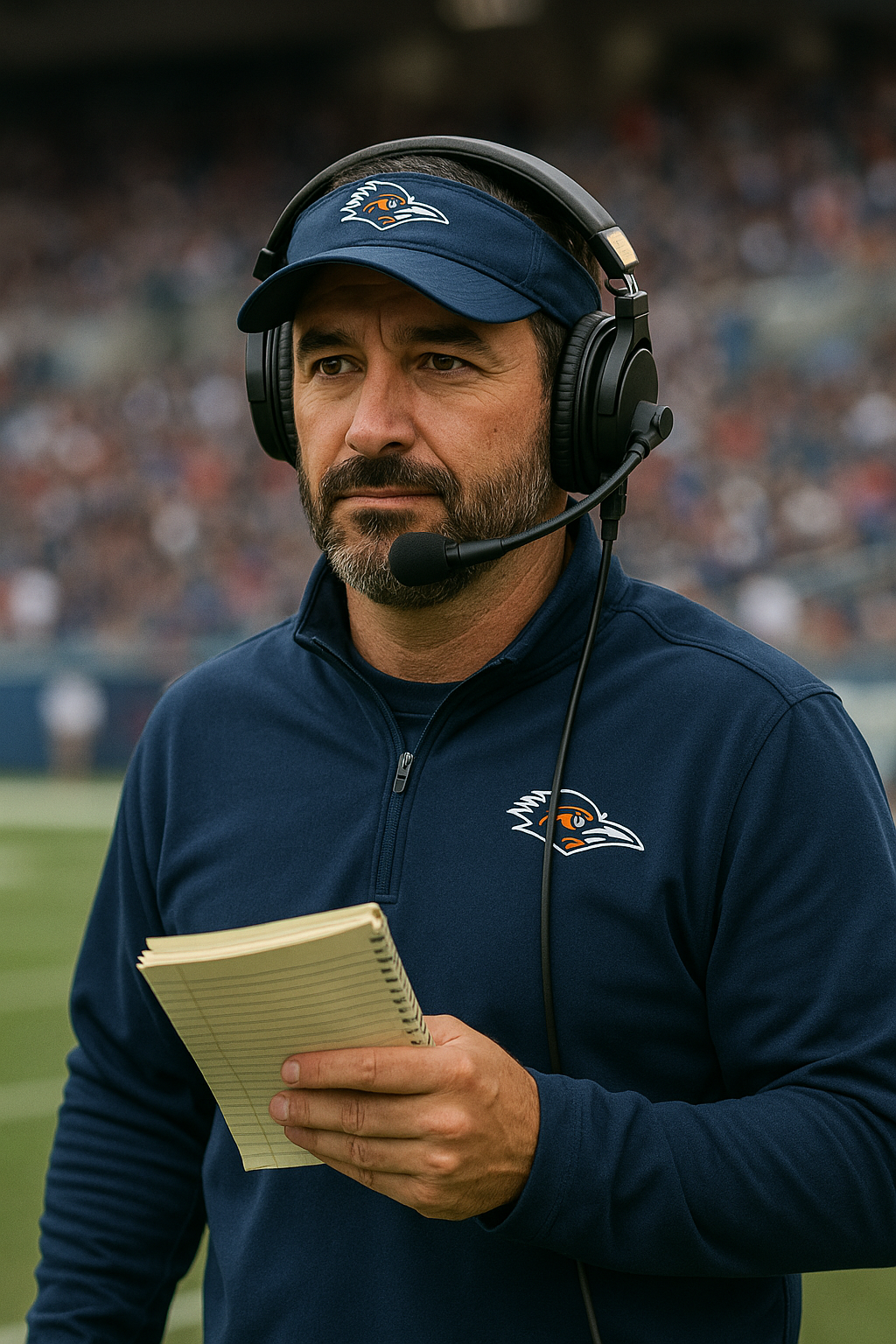
Frankie Calderón, better known across Texas airwaves as “The Horn,” is a no-nonsense football lifer with a sharp tongue and a soft spot for the underdog. Raised just outside of Pueblo, Colorado, Frankie cut his teeth covering JUCO ball and D2 programs before turning heads with his bold coverage of the Western Colorado Mustangs — and one fiery young coach named Clay Merritt.
When Merritt made the leap to UTSA, Frankie followed — not as a coach, but as the unofficial voice of the program, launching Runner Nation Radio and embedding himself in the culture of the team.
Fans love him. Opposing coaches fear him. And Stonewall? He respects the hell out of him.
THE MORNING AFTER — WEEK 5: Gator Reality Check, Bama Rolls & Penn State Panic