Everyone’s Best Shot: UTSA Survives ECU 35–28, Falls to No. 10

There comes a time in every successful season when the journey changes.
The opponent no longer sees your name on the schedule and wonders whether it belongs on the same field. It studies your weaknesses, memorizes your mistakes and spends the entire week imagining what it would feel like to become the team that finally brings you down.
The hunter becomes the hunted.
No. 8 UTSA arrived in Greenville carrying a national championship, an undefeated record and a 22-game winning streak. The Roadrunners left with all three still intact after surviving East Carolina 35–28.
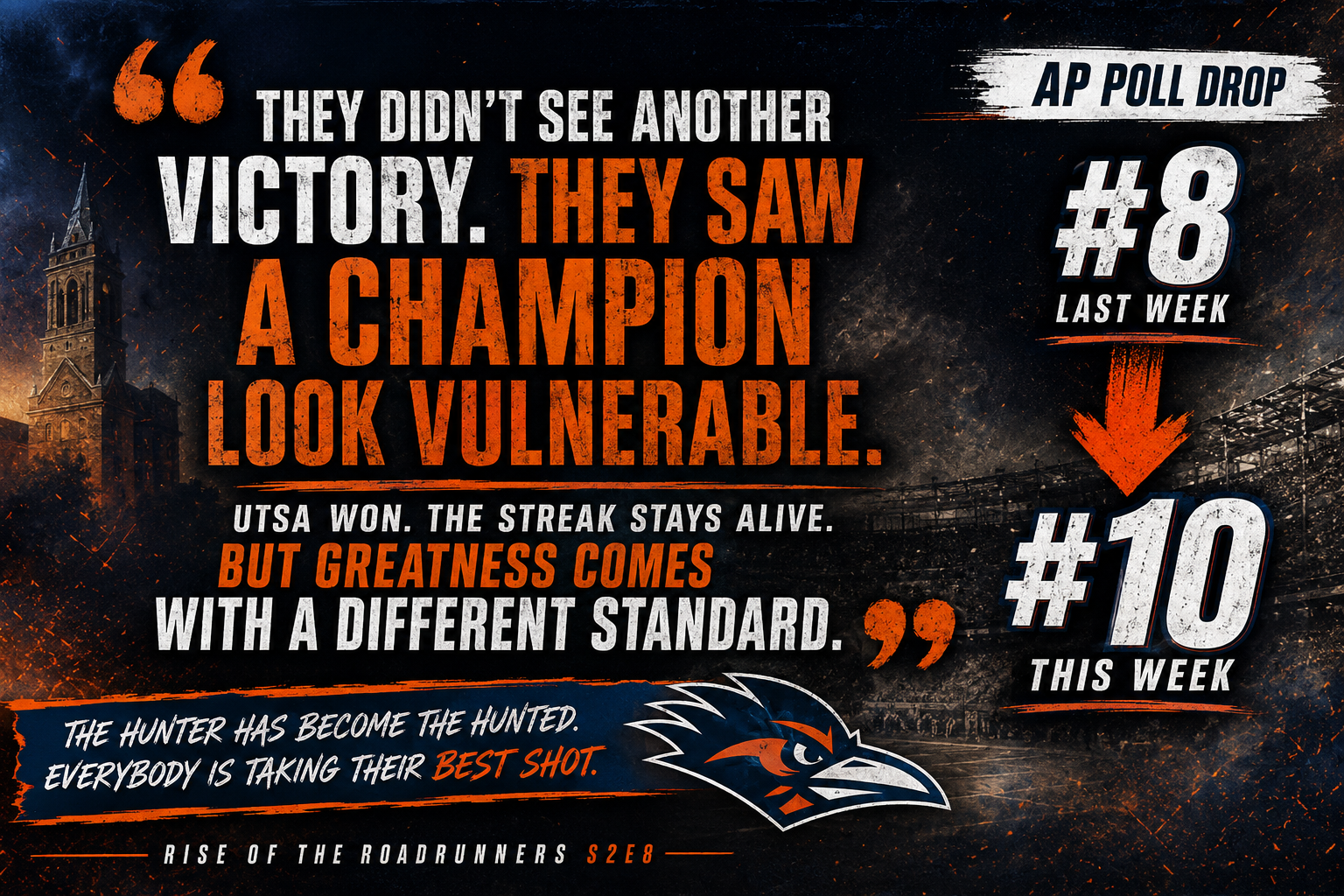
They also returned to San Antonio ranked No. 10 in the country.
That is the strange tax attached to greatness. UTSA won a conference road game against a 4–2 opponent that entered undefeated in American Conference play, yet still fell two spots in the rankings. The voters did not see another victory. They saw a champion look vulnerable.
Last season, UTSA carried the edge and swung the sword while climbing toward the top of the mountain. Every victory brought the Roadrunners closer to something their program had never touched.
This season, they are already standing at the summit.
The climb is over. Now comes the harder task of staying there while every challenger arrives with fresh legs, sharpened steel and nothing to lose.
East Carolina nearly became the monster that ended this chapter of the Roadrunners’ odyssey. Instead, UTSA learned, adapted and overcame in real time.
Not beautifully.
Not comfortably.
But completely.
Because defending a national championship is no longer about proving UTSA can play better football than everybody else. It is about proving, week after week, that the Roadrunners are disciplined enough to survive everyone’s best shot.
A Championship Start in Hostile Waters
For most of the opening quarter, UTSA looked exactly like the team everyone expected to see.
Calm. Explosive. Ruthless.
Wayshawn Parker touched the football on the first play and immediately gashed the Pirates through the middle, carrying the Roadrunners from their own territory to midfield. It was the opening note of another masterful performance from the most dangerous running back in college football.
Parker continued cutting through the ECU defense until Owen McCown found senior captain Devin McCuin on a slant for the first touchdown of the afternoon.
Six plays.
Seventy-nine yards.
Barely more than a minute removed from the game clock.
UTSA had entered hostile territory and silenced it before most of the crowd had settled into its seats.
The Roadrunners’ defense forced a punt, Mekhi Anderson flipped the field with an explosive screen reception and McCown finished the second drive himself. The senior quarterback escaped the pocket, made a defender miss and crossed the goal line to give UTSA a 14–0 advantage.
For one quarter, the game appeared ready to follow the familiar script.
UTSA had scored touchdowns on both possessions. ECU had been shut out. Parker was already approaching 100 rushing yards, McCown was controlling the offense and the Pirates appeared incapable of matching the Roadrunners’ speed.
But East Carolina had not come to admire the champions.
The Pirates had come to drag them into deep water.
East Carolina Refused to Disappear
ECU’s first scoring drive offered the earliest warning that this afternoon would not become another UTSA runaway.
Quarterback Katin Houser stayed composed against pressure, extended the possession and finally found Ja’Quize Pettaway in the end zone. The 10-play, 81-yard march cut the lead to seven and gave the crowd permission to believe.
UTSA answered exactly as a championship team should.
Parker continued wearing down the defense. Anderson moved the chains on third down. McCown patiently worked the Roadrunners back into the red zone before finding Isaiah Butler-Tanner for a touchdown.
The freshman tight end had become an increasingly trusted part of the offense, and his first score restored the 14-point advantage.
At 21–7, UTSA had regained control.
Then one throw changed the emotional temperature of the entire game.
With a little more than a minute remaining before halftime, McCown attempted to force the football into double coverage. Krystian Williams stepped in front of it and did not merely intercept the pass. He returned it all the way to the end zone.
Pick-six.
A drive that could have placed the game beyond ECU’s reach instead became the play that pulled the Pirates back into it.
That is how quickly control disappears on the road.
One decision.
One defender.
One sprint in the opposite direction.
UTSA’s advantage had been cut to 21–14, ECU would receive the second-half kickoff and a crowd that had been quiet for most of the afternoon suddenly sounded convinced it was about to witness history.
What happened next mattered almost as much as the mistake itself.
McCown did not hide from it.
He returned to the field with 61 seconds remaining and directed the type of drive that defines a veteran quarterback. Anderson hurdled a defender to ignite the possession. Butler-Tanner moved the ball across midfield. Parker broke loose and carried UTSA inside the 10.
Then McCown went back to the freshman tight end.
Touchdown, Butler-Tanner.
Five plays. Eighty-one yards. An immediate answer.
McCown had handed ECU seven points and then marched directly back down the field to reclaim them. That sequence captured both sides of his afternoon: the costly decisions that made the game difficult and the resilience that ensured those decisions did not become fatal.
UTSA entered halftime leading 28–14.
The offense had scored touchdowns on four of its five possessions.
Everything appeared stable again.
Then the second half began.
One Hundred Yards of Pure Chaos
There are moments when a stadium seems to inhale together.
Ja’Quize Pettaway gave East Carolina one of them.
Pettaway fielded the second-half kickoff at the goal line, broke through the first wave and found open grass. By the time the Roadrunners realized the danger, nobody remained between him and the end zone.
One hundred yards.
Touchdown, Pirates.
The 14-point halftime advantage lasted only seconds.
The same UTSA team that had spent the first half controlling the line of scrimmage and dictating nearly every possession suddenly found itself holding a seven-point lead in front of a crowd that had completely lost its mind.
The Roadrunners attempted to answer, but the afternoon continued sliding sideways.
McCown found Butler-Tanner in space. The freshman broke a tackle and turned upfield, only to have the football knocked loose.
East Carolina recovered.
UTSA had now committed two turnovers, surrendered a defensive touchdown and allowed a kickoff to be returned the length of the field.
The Pirates had all the momentum and an opportunity to tie the game.
This was no longer a test of talent.
It was a test of balance.
When an afternoon begins breaking apart, championship teams must resist the temptation to chase every mistake. They must remain composed enough to play the next snap rather than attempting to fix the entire game with one heroic act.
Kaden Meier provided exactly that.
Houser moved ECU into scoring position and attempted to attack the end zone. Meier read the throw, stepped into its path and intercepted it.
For the first time all afternoon, the Roadrunners had created a turnover of their own.
They needed it desperately.
Parker immediately carried UTSA back down the field. McCown completed his 100th pass of the season. The Roadrunners reached the ECU red zone and appeared prepared to restore order.
Then the field-goal attempt struck the upright.
No points.
At that stage, nothing felt accidental anymore. Every mistake seemed connected to the next. Every bounce favored the Pirates. Every opening UTSA created seemed to close before the Roadrunners could step through it.
The defending champions entered the fourth quarter leading only 28–21.
The Streak Became a Noose
The greatest danger of a long winning streak is that eventually it can stop feeling like proof of success and begin feeling like something a team is terrified to lose.
For 22 games, UTSA’s streak represented the strength of Clay “Stonewall” Merritt’s program.
In the fourth quarter at East Carolina, it began tightening around the Roadrunners’ necks.
Houser methodically marched the Pirates down the field. He converted third downs, found Pettaway in space and punished breakdowns in UTSA’s zone coverage. When the Roadrunners focused on the running back, Houser kept the read option himself.
He crossed the goal line.
Touchdown, East Carolina.
Tie game.
Twenty-eight apiece.
The crowd in Greenville erupted. ECU had erased a 14-point deficit, survived UTSA’s offensive explosions and dragged the defending champions into a game that would be decided by execution in the final minutes.
There was no poll ranking on the field anymore.
No national championship banner.
No memory of last season.
There were only 11 Roadrunners, 11 Pirates and a little more than four minutes left to determine whether UTSA’s reign would continue.
This is the point where champions reveal what remains beneath the crown.
Mr. Reliable Answers the Call
UTSA’s winning drive began about as poorly as possible.
McCown kept the football on the read option and was dropped for a three-yard loss. On second down, he attempted to find Parker out of the backfield, but the running back was hit immediately.
Third-and-13.
The stadium stood.
The Pirates could feel the upset moving toward them. One more stop would return the football to an offense that had spent the second half slicing through UTSA’s secondary.
McCown took the snap and went to the player who had been there whenever the Roadrunners needed stability.
Mekhi Anderson.
Mr. Reliable.
Anderson settled into the open area, secured his seventh reception and carried the football across midfield. The conversion did more than extend the drive. It allowed UTSA to breathe.
McCown returned to Anderson for another first down. Parker continued fighting through the physical toll of a 237-yard afternoon. On third-and-nine, McCown found Butler-Tanner, who laid out to make one of the best catches of the game.
Earlier, the freshman had put the football on the ground and given ECU another opportunity.
Now, with the game tied and the streak hanging in the balance, McCown trusted him again.
That is the culture Merritt has been attempting to build.
A mistake does not exile a player from the game plan.
It creates the opportunity to respond.
Butler-Tanner responded.
Anderson responded.
McCown responded.
UTSA reached the two-yard line, where Bryson O’Donnell was asked to finish the drive. ECU stopped him twice, but Merritt refused to abandon the physical challenge.
Third-and-goal from the one.
O’Donnell took the handoff again.
This time, he crossed the line.
Touchdown, Roadrunners.
With 1:29 remaining, UTSA led 35–28.
The drive was not defined by one spectacular play. It was defined by a collection of players refusing to allow their worst moment to become the final word.
That is what defending the standard actually looks like.
One Final Pirate Attack
East Carolina still had time.
What it did not have were timeouts.
Houser completed a pass to Cayman Reynolds and moved the Pirates toward midfield. Pettaway found another opening in UTSA’s coverage and carried ECU into Roadrunner territory.
The seconds continued disappearing, but the Pirates refused to panic.
Houser found Pettaway again for a first down at the UTSA 19. ECU spiked the football and prepared for four opportunities to force overtime.
From my seat in the booth, this was the most stressful sequence of the entire Rise of the Roadrunners journey.
The Roadrunners had already surrendered a pick-six.
They had allowed a 100-yard kickoff return.
They had committed another turnover.
They had missed a field goal.
They had failed to record a sack against an offensive line that became the first this season to keep UTSA’s Southwest Sack Exchange off the board.
Now the defense had to preserve the streak from inside its own red zone.
Houser attacked the corner of the end zone. Meyer, already responsible for the interception that changed the third quarter, knocked the pass away.
Nnanna Anyanwu nearly reached Houser on the next play, forcing another incompletion.
Fourth-and-10.
Twenty-seven seconds remained.
ECU completed the pass underneath.
The receiver turned toward the marker.
UTSA closed.
He was brought down short.
Turnover on downs.
For the 23rd consecutive game, the Roadrunners had found a way to win. The final stand ended the most dangerous upset attempt UTSA has faced during its two-season rise.
The Numbers Say UTSA Dominated
The scoreboard tells the truth, but it rarely tells the entire story.
UTSA finished with:
- 26 first downs to ECU’s 16
- 498 yards of offense to ECU’s 290
- 200 rushing yards
- 298 passing yards
- A 6-of-9 performance on third down
- A clear advantage in possession
- More than 230 total yards from Parker alone
Those numbers describe a comfortable UTSA victory.
The game was anything but comfortable.
East Carolina did not remain competitive by consistently moving the football better than the Roadrunners. The Pirates remained competitive because they dominated the moments that change games.
A pick-six.
A 100-yard kickoff return.
A forced fumble.
Nine third-down conversions.
Zero sacks allowed.
UTSA controlled the majority of the snaps. ECU controlled several of the afternoon’s largest emotional swings.
Football does not reward the team with the prettier box score.
It rewards the team that survives all 60 minutes.
Give the Pirates Their Flowers
East Carolina deserves more than a dismissive mention in a story about UTSA’s mistakes.
The Pirates played with discipline, belief and an aggression that never disappeared—even after falling behind 14–0 in the first quarter.
Katin Houser Never Flinched
Houser completed 24 of 34 passes for 220 yards, threw a touchdown and added another score with his legs.
His lone interception was costly, but he refused to unravel afterward. Houser continued attacking UTSA’s secondary and nearly completed the tying drive in the final minute.
He played like a quarterback who believed the game belonged to him.
Ja’Quize Pettaway Changed the Afternoon
Pettaway finished with six receptions for 79 yards and a touchdown, but those numbers only tell part of his story.
His kickoff-return touchdown transformed the second half before UTSA’s offense had touched the football. He repeatedly found space against the Roadrunners’ coverage and became Houser’s most dangerous target during the final drive.
Whenever ECU needed life, Pettaway supplied it.
The Pirates’ Defense Created Its Own Points
Krystian Williams recorded seven tackles and delivered the game’s first seismic momentum swing with his pick-six.
Demari Henderson contributed seven tackles and helped create another turnover by forcing the Butler-Tanner fumble.
Jackson Baxter added six tackles and two tackles for loss, helping ECU turn the red zone into a physical fight rather than a formality.
Most impressively, the Pirates became the first offensive line this season to keep UTSA from recording a sack.
East Carolina did not receive a moral victory Saturday afternoon.
The Pirates earned genuine respect.
They walked onto the field believing the champions could bleed—and came within one possession of proving they could fall.
Roadrunners Defending the Standard
UTSA made enough mistakes to lose.
Its best players also made enough plays to prevent it.
Owen McCown: Imperfect, but Unbroken
McCown completed 22 of 33 passes for 298 yards and three touchdowns. He added 18 yards and another score on the ground.
His pick-six was one of the worst decisions he has made this season. It placed ECU back into a game UTSA had largely controlled.
His response was more important.
McCown led an 81-yard touchdown drive immediately after the interception. He converted third-and-13 with the game tied. He trusted Butler-Tanner after the freshman’s fumble and directed the decisive scoring drive in the fourth quarter.
Quarterbacks are not defined by whether they make mistakes.
They are defined by whether the offense still believes in them afterward.
UTSA never stopped believing in McCown.
Wayshawn Parker: The Engine Keeps Running
Parker carried the football 18 times for 178 yards—an average of nearly 10 yards per attempt.
He also caught three passes for 59 yards, finishing with 237 yards from scrimmage.
Six games into the season, Parker crossed the 1,000-yard rushing mark. That achievement would define an entire year for most running backs.
For Parker, it arrived before November.
UTSA survived because whenever the offense needed to rediscover its identity, it placed the football in No. 1’s hands.
Mekhi Anderson: Mr. Reliable
Anderson caught nine passes for 152 yards, producing 116 of those yards after the catch.
His importance went beyond the final numbers.
He converted third downs. He created explosive plays from simple throws. He steadied the offense after mistakes. Most importantly, he delivered the third-and-13 reception that kept the winning drive alive.
When the game became chaotic, Anderson remained predictable in the best possible way.
Open.
Dependable.
Ready.
Isaiah Butler-Tanner: Redemption in Real Time
Butler-Tanner caught seven passes for 59 yards and two touchdowns.
He also lost a fumble that nearly allowed ECU to tie the game in the third quarter.
Merritt and McCown did not remove him from the story.
They handed him an opportunity to rewrite it.
His diving third-down reception on the final drive was one of the game’s defining moments. The freshman did not erase his mistake. He overcame it.
That lesson will last longer than any touchdown.
Kaden Meyer and Nnanna Anyanwu Hold the Line
Anyanwu led UTSA with nine tackles, including two tackles for loss, and nearly reached Houser during the final stand.
Meyer recorded six tackles, intercepted Houser in the third quarter and later broke up a pass in the end zone during ECU’s final possession.
The Roadrunners’ defense did not deliver its cleanest performance, but Meyer made the two biggest plays when UTSA could least afford another breakdown.
Why UTSA Fell From No. 8 to No. 10
The rankings drop should not be ignored.
UTSA won, remained undefeated and extended the nation’s most important winning streak to 23 games. Yet the Roadrunners still fell from No. 8 to No. 10.
That is not necessarily fair.
It is also the reality of defending a championship outside college football’s traditional power structure.
A blue-blood program survives a conference road game and gets praised for its toughness.
UTSA survives one and is asked whether the magic is disappearing.
The Roadrunners no longer receive credit merely for winning. Voters expect control, dominance and a level of weekly perfection no football team can realistically maintain.
Still, the ranking drop contains a warning UTSA should accept.
Charlotte exposed cracks.
Rice exposed more.
East Carolina nearly broke through them.
The Roadrunners have now spent three consecutive games learning how quickly turnovers, coverage mistakes and special-teams failures can transform an inferior statistical performance from an opponent into a legitimate upset opportunity.
Falling two spots does not threaten UTSA’s season.
Failing to learn from why it happened might.
The voters saw a team that looked vulnerable.
I saw a team receive a championship-level lesson without paying for it with a championship-ending loss.
Polls fluctuate.
The standard cannot.
Next Stop: Philadelphia
UTSA’s road journey continues next week against Temple at Lincoln Financial Field.
The Owls enter at 5–2 overall and 3–0 in American Conference play. They have already defeated FCS East, Coastal Carolina, USF, UConn and Army, positioning themselves as another legitimate obstacle in the conference race.
They will also remember last season.
UTSA shut Temple out 28–0 during the Roadrunners’ national championship run. Instead of allowing that defeat to destroy their progress, the Owls appear to have used it as permission to improve.
Now Temple gets another opportunity.
Another home crowd.
Another nationally ranked UTSA team.
Another chance to become the program that ends the streak.
It will be the Roadrunners’ third game in a three-game road stretch, and fatigue can no longer be treated as an excuse. Temple will have studied everything Charlotte, Rice and East Carolina exposed.
The Owls will arrive with their own plan.
Their own belief.
Their own best shot.
The Final Word From Frankie Calderón
Last season, UTSA climbed the mountain with a sword in its hand and possibility in its heart.
The Roadrunners were building toward something.
Every game brought them closer to the summit. Every victory gave San Antonio another reason to believe the impossible might be waiting at the end of the journey.
This season is different.
UTSA already knows what waits at the top.
The Roadrunners also know how lonely and dangerous the summit can become.
East Carolina did not fear them. The Pirates attacked their weaknesses, accepted every opening and carried the fight into the final seconds. For long stretches, UTSA appeared caught between protecting what it had built and remembering the fearless identity that built it.
But champions are not teams that live free of chaos.
They are teams that remain themselves when chaos arrives.
UTSA made mistakes.
UTSA lost control.
UTSA watched a 14-point advantage disappear.
Then, with the game tied, the crowd roaring and 22 consecutive victories tightening around its neck, the Roadrunners drove the length of the field, reached the end zone and made one final stand.
East Carolina loaded every punch it had.
UTSA absorbed them all.
The Roadrunners may have fallen two spots in the rankings, but they did not fall from the mountain.
Not yet.
Final: UTSA 35, East Carolina 28.
Winning streak: 23.
The standard: defended.
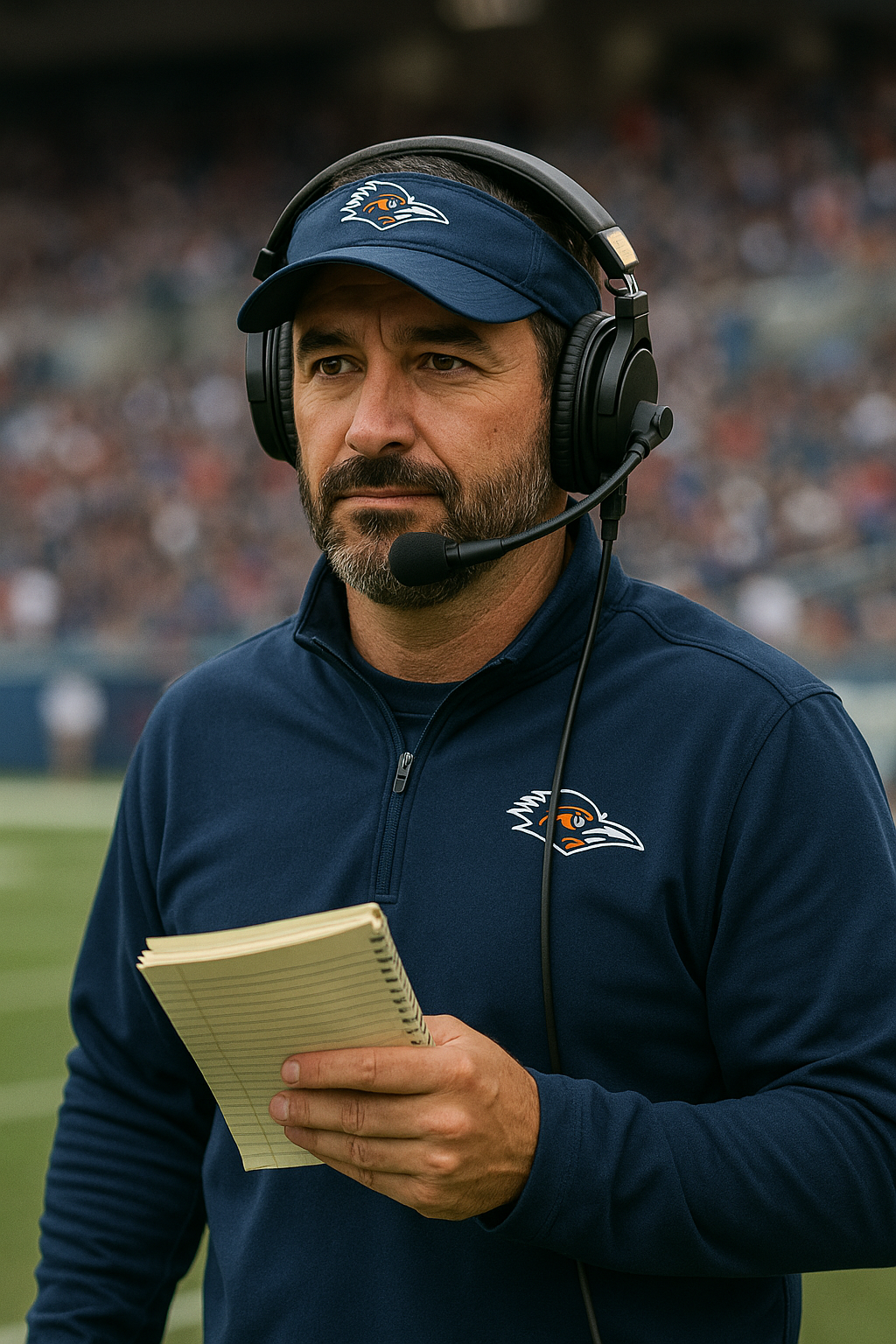
Frankie Calderón, better known across Texas airwaves as “The Horn,” is a no-nonsense football lifer with a sharp tongue and a soft spot for the underdog. Raised just outside of Pueblo, Colorado, Frankie cut his teeth covering JUCO ball and D2 programs before turning heads with his bold coverage of the Western Colorado Mustangs — and one fiery young coach named Clay Merritt.
When Merritt made the leap to UTSA, Frankie followed — not as a coach, but as the unofficial voice of the program, launching Runner Nation Radio and embedding himself in the culture of the team.
Fans love him. Opposing coaches fear him. And Stonewall? He respects the hell out of him.

College Football Carnage, Bo Nix Under Fire & NBA Tip-Off | FeOTB Ep 294