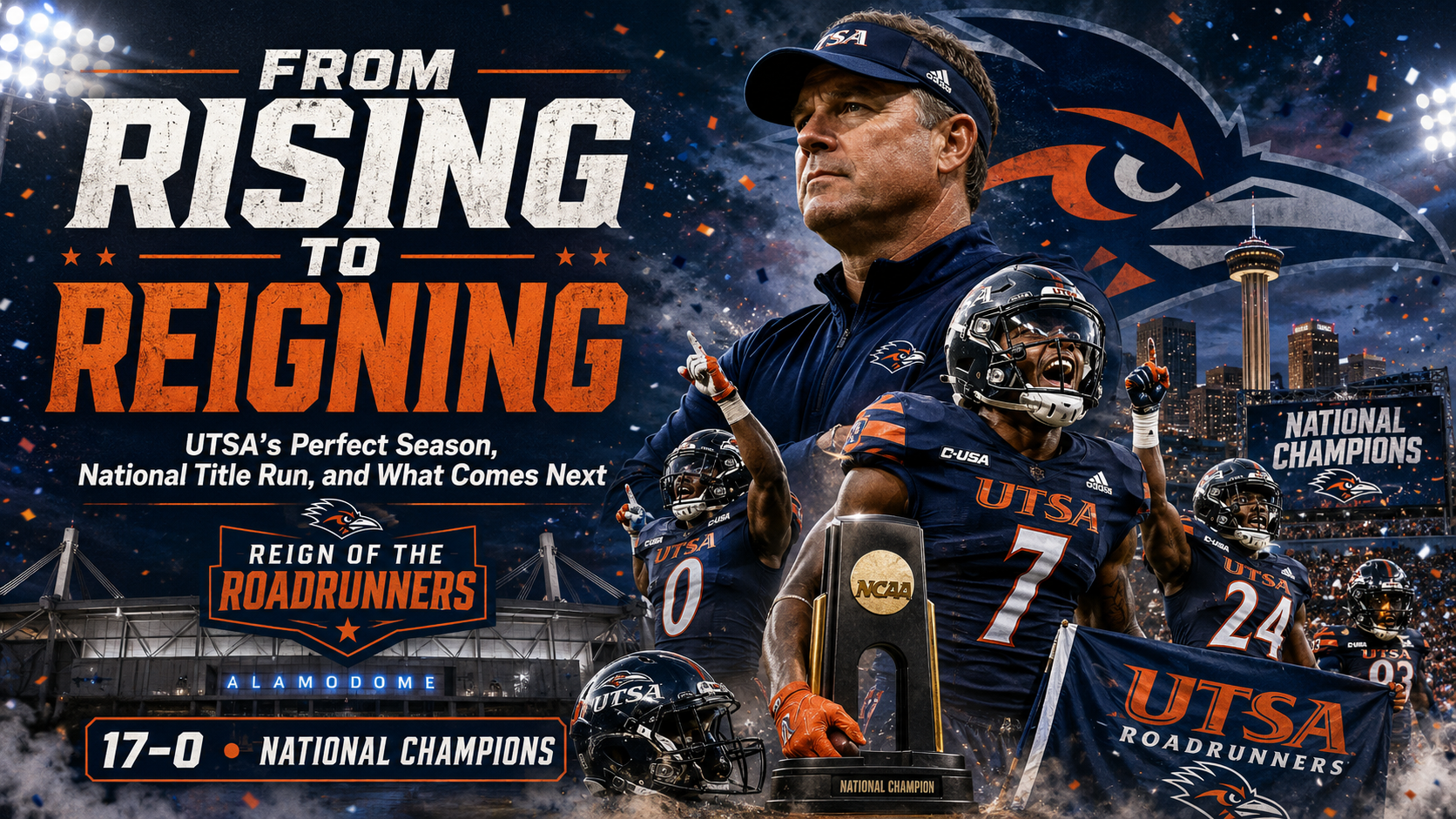
From Rising to Reigning: UTSA’s Perfect Season, National Title Run, and What Comes Next
There are seasons you remember.
There are teams you celebrate.
Then there are years that stop being a schedule and start becoming scripture.
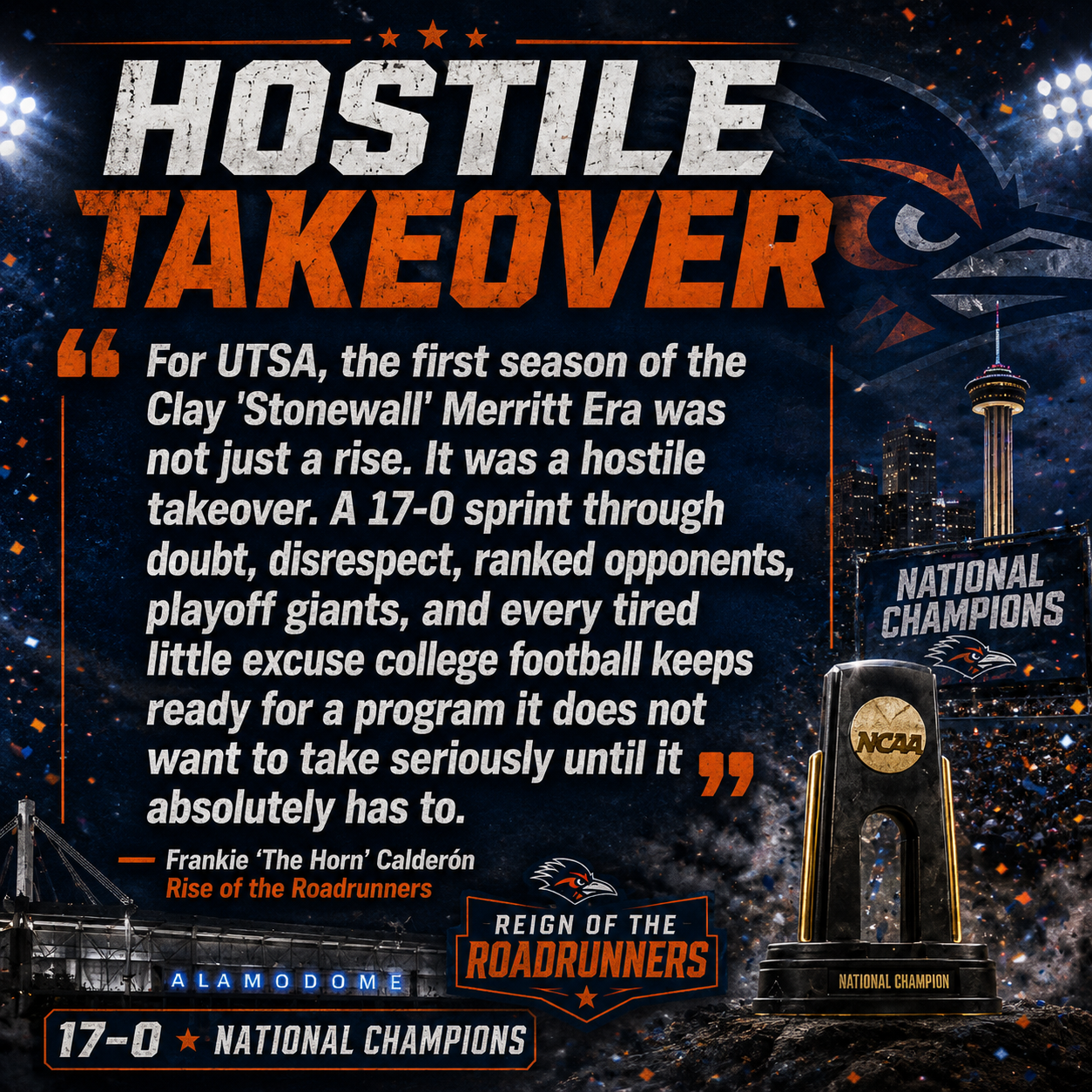
For UTSA, the first season of the Clay “Stonewall” Merritt Era was not just a rise. It was a hostile takeover. A 17-0 sprint through doubt, disrespect, ranked opponents, playoff giants, and every tired little excuse college football keeps ready for a program it does not want to take seriously until it absolutely has to.
The Roadrunners did not stumble into a national championship.
They took the crown.
They planted the flag.
They made everyone else deal with it.
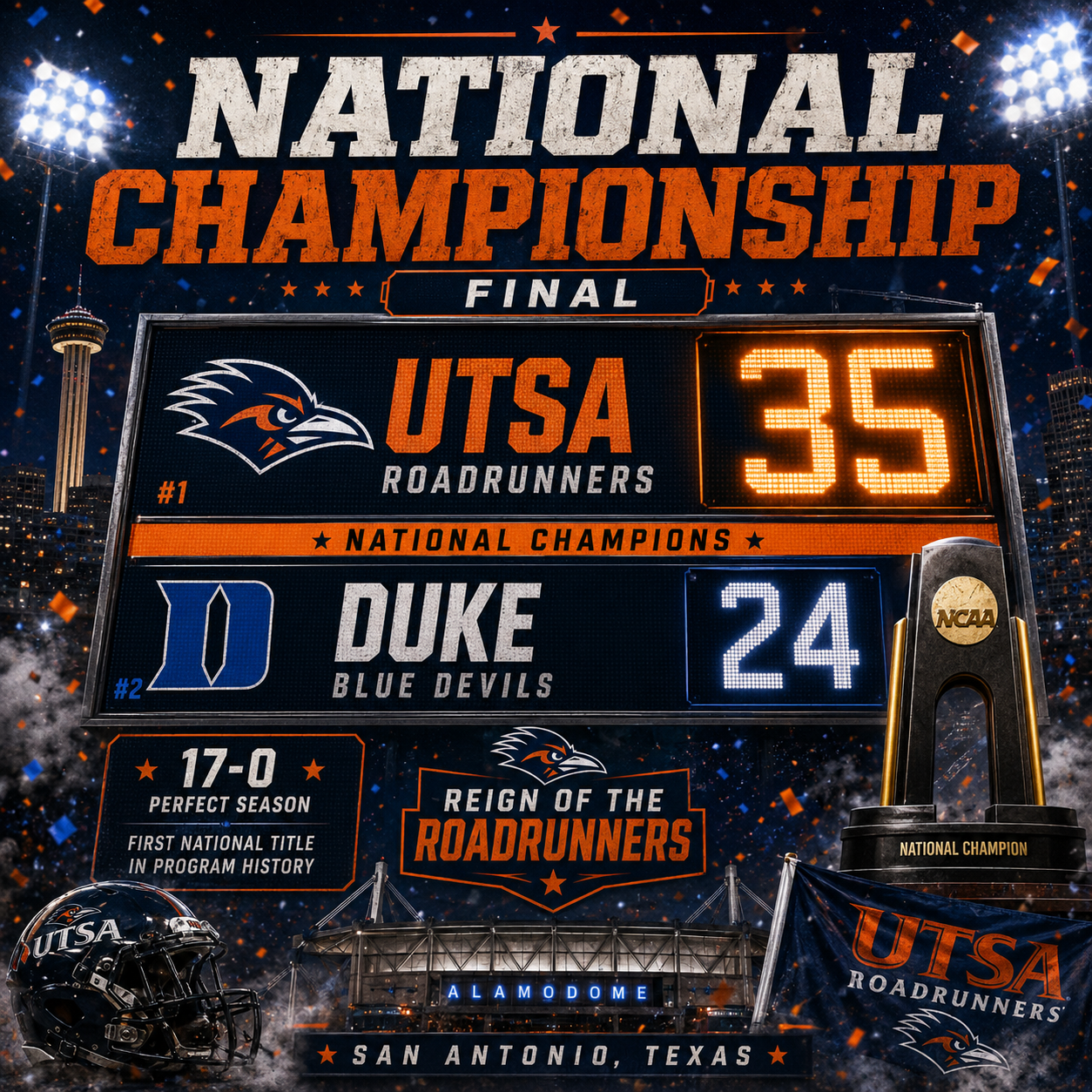
From Kyle Field to the Alamodome, from Fort Collins to Tuscaloosa, from the Caesars Superdome to the national championship stage against Duke, UTSA went from interesting story to unavoidable problem. By the time the final whistle hit on a 35-24 win over the Blue Devils, there was nothing left to debate.
The Roadrunners were not cute.
They were not lucky.
They were not some little Group of Five side quest.
They were national champions.
And now, Runner Nation, the story changes.
Season 1 was about rising.
Season 2 is about reigning.
Welcome to Reign of the Roadrunners.
The Birth of the Stonewall Merritt Era
For anyone just now finding the signal, this is Rise of the Roadrunners, the College Football 26 dynasty story of Coach Clay “Stonewall” Merritt taking over UTSA and turning a young FBS program into the most dangerous bird in America.
I’m Frankie “The Horn” Calderón, coming to you through Runner Nation Radio, where the coffee is strong, the takes are stronger, and the Alamodome is still echoing from a title run nobody outside San Antonio wanted to believe was possible.
Merritt arrived at UTSA as a former Division II legend and Western Colorado coach stepping into the role of Group of Five program builder. That sounds nice and clean on paper. In reality, it was a whole lot messier.
This was a coach from Rifle, Colorado, shaped by Western Colorado, hardened in the RMAC, and built on the kind of blue-collar foundation that does not photograph well but wins when the lights come on. Merritt is not a carnival barker. He is not selling fake juice. He is not screaming into microphones to prove he has control of a room.
He is quiet.
Measured.
Stoic.
Uncomfortable selling himself.
And absolutely obsessed with controlling what can be controlled.
That is the whole Stonewall code.
Control your effort. Control your preparation. Control your response. Let the outcome show the work.
Merritt does not ask his players to control the scoreboard. He asks them to control the snap in front of them. He does not ask them to become famous. He asks them to become dependable. He does not chase hype. He builds habits until the hype has no choice but to follow.
And in Year 1, the hype got dragged behind the machine.
Before the Crown, There Was Kyle Field
Before UTSA became the national champion, it had to walk into the lion’s den and prove it was not scared.
That first test came at Kyle Field against Texas A&M.
A first-time head coach. A young Roadrunners program. SEC country. All the noise. All the tradition. All the built-in excuses for why UTSA was supposed to show up, take the check, take the beating, and go back home proud of competing.
Instead, the Roadrunners won 49-3.
Let me say that slower for the people in the expensive seats.
UTSA 49. Texas A&M 3.
That was not an upset. That was a crime scene with shoulder pads.
Kyle Field became the first major warning shot of the Stonewall Merritt Era. The Roadrunners did not sneak out with some lucky last-second field goal. They embarrassed a ranked SEC opponent in its own house and turned the national conversation from “Who is this guy?” to “Hold on… is UTSA serious?”
Yes.
Very.
Once Is a Fluke. Twice Is a Pattern.
The next week, Texas State came into the I-35 Showdown and ran directly into the buzzsaw.
UTSA 58. Texas State 0.
Rivalry game? Sure.
Competitive? Not even a rumor.
Texas State finished with 27 total yards and 2 first downs. UTSA’s defense had allowed only 3 points through the first two games of the season. The Roadrunners did not just beat a rival. They put the rivalry in a headlock and made it tap out in front of everybody.
This was the week where the Alamodome started feeling less like a home stadium and more like a warning label.
Owen McCown looked calm, clean, and in control. Robert Henry Jr. kept ripping through defenses like he was personally offended by arm tackles. Devin McCuin started flashing the big-play ability that would become a weekly problem for defensive coordinators. Mekhi Anderson got loose in the return game. Cameron Blaylock and the front seven started introducing themselves to quarterbacks in a very unfriendly manner.
Once is a fluke.
Twice is a pattern.
And by Week 2, the pattern was violence.
Are You Not Entertained?
Then Maryland came to San Antonio.
Big Ten logo. Power conference confidence. Another chance for people to say, “Okay, now we’ll find out if UTSA is real.”
Final score: UTSA 68, Maryland 0.
Through three weeks, the Roadrunners had scored 175 points and allowed 3.
Three.
The Alamodome became the Coliseum. The Roadrunners were not just winning. They were turning Saturdays into public demonstrations. Owen McCown threw five touchdowns to five different receivers. Robert Henry Jr. left with an injury, and the running back room still added two rushing scores like the machine did not even blink. Mekhi Anderson recorded his second punt return touchdown in two weeks.
And the defense?
That was the day the nickname became real.
The Southwest Sack Exchange was no longer just a clever line for a broadcast. It became the soul of the team. UTSA recorded double-digit sacks and held Maryland to negative rushing yards. The Roadrunners were not bending. They were not breaking. They were not negotiating.
They were hunting.
Fort Collins Showed UTSA’s Spine
Every great team has a moment where the fireworks stop and the fight starts.
For UTSA, that came in Week 4 at Colorado State.
The final was 28-21, Roadrunners. But that score tells you more about UTSA than the blowouts did.
Colorado State ended the shutout streak. The Rams forced the first real fourth-quarter fight of the Merritt Era. Owen McCown threw a late pick-six that tied the game at 21. For the first time all season, UTSA looked human. For the first time, the Roadrunners had to answer without the Alamodome rocking behind them.
And that is exactly what they did.
McCown responded with the biggest drive of the season to that point. Robert Henry Jr. punched in the game-winning score. The Roadrunners survived altitude, pressure, mistakes, and the kind of ugly football that exposes whether a team has a backbone or just a highlight reel.
The blowouts showed UTSA’s ceiling.
Fort Collins showed UTSA’s spine.
That game mattered because national champions do not just win when the band is playing and the offense is flying. They win when the game gets weird. They win when the quarterback makes a mistake and has to live with it. They win when the other sideline smells blood.
UTSA passed that test.
Then the American Conference had to deal with the aftermath.
The Question Changed in Conference Play
UTSA entered American Conference play 4-0.
By then, this was no longer a cute September story. The Roadrunners had already passed four different exams: an SEC road statement, a rivalry demolition, a Big Ten destruction, and a road survival test at altitude.
Conference play was not a step down.
It was the next chapter.
Temple got blanked on Broad Street. Rice had class cancelled. North Texas got a lesson in respect on the road. Tulane was told to respect the beep. USF watched UTSA plant the flag at No. 24. Charlotte got buried 87-0 as the Roadrunners climbed to No. 21 and started appearing in College Football Playoff projections. East Carolina caught an 88-0 statement at the Alamodome. Army senior night ended 77-0 as UTSA clinched a home AAC title game.
Every week, someone asked if UTSA was real.
Every week, the Roadrunners answered louder.
The regular season became a weekly argument with the committee, the rankings, the skeptics, and anyone still trying to call this program cute. By the end of it, UTSA was not asking for respect anymore.
It was collecting receipts.
The Playoff Was Not Too Big. It Was Too Late.
The AAC Championship brought No. 21 Navy to San Antonio against No. 17 UTSA.
The Roadrunners won their first conference title at home. The American belonged to UTSA. The Roadrunners punched their ticket into the College Football Playoff as the 12-seed.
And because college football has a sense of humor, UTSA’s first playoff game in school history came on the road in Tuscaloosa against No. 5 Alabama.
The moment was supposed to be too big. The brand was supposed to be too powerful. The Tide was supposed to remind the little guys where they stood.
Instead, UTSA demolished Alabama 63-6.
Bryant-Denny became another Roadrunner crime scene.
The Roadrunners did not just beat Alabama. They removed every lazy argument from the table. Strength of schedule? Watch the tape. SEC speed? Watch the scoreboard. Playoff pressure? Ask the Tide how much pressure they felt while chasing Devin McCuin and watching the Southwest Sack Exchange turn the backfield into rush hour traffic.
Then came Big 12 champion Texas Tech in the quarterfinal at the Caesars Superdome.
Another win.
Then Oregon in the semifinal.
Another win.
At that point, UTSA had gone from underdog to unavoidable.
The rise was complete.
Only the crown remained.
UTSA 35, Duke 24: The Crown Comes Home
Duke was the blue-blood style opponent.
Size. Pedigree. Confidence. ACC swagger. The kind of program that walks into a title game believing the stage belongs to them because history told them so.
UTSA walked in with belief, grit, and a chip on the shoulder big enough to block out the sun.
The championship game had everything a title fight should have. Momentum swings. Defensive answers. Special teams fireworks. A late push from the opponent. A moment where the whole season hung in the air and asked one question:
Do you finish?
Vic Shaw helped answer early. With injuries forcing movement around the defense, Shaw stepped into a different role and still delivered a tone-setting interception. Robert Henry Jr. scored immediately after the turnover, because of course he did. That man spent the whole season turning opportunity into punishment.
Then Mekhi Anderson hit the button.
A 97-yard kickoff return touchdown in the national championship game.
That is not a play. That is a citywide power surge.
Duke made its push. McCown threw an interception late. The Blue Devils tried to drag UTSA into the kind of panic that breaks dream seasons right before the finish line.
But when the Roadrunners needed one more stop, the Southwest Sack Exchange answered.
Fourth down. Near midfield. Season on the line.
Stop.
Ballgame.
Crown.
UTSA 35. Duke 24.
17-0.
National champions.
The Roadrunners did not stumble into the crown. They took it, planted the flag, and made everyone else deal with it.
The Legends of the Perfect Season
Every perfect season needs names that become bigger than the stat sheet.
UTSA had plenty.
Owen McCown: The Steady Hand
Owen McCown entered the season as the calm left-handed quarterback trusted to guide the Merritt Era. Early in the year, he showed poise, efficiency, and command. But the moment that made him more than a blowout quarterback came in Fort Collins.
After the late pick-six against Colorado State, McCown could have folded. Instead, he led the game-winning drive and proved the Roadrunners had a quarterback who could answer after getting hit in the mouth.
Now McCown enters Season 2 with the kind of production that changes expectations: 81% completion, 2,449 passing yards, 42 passing touchdowns, 6 rushing touchdowns, 3 interceptions, plus 258 rushing yards and 3 more scores on the ground.
He is not guiding a surprise anymore.
He is quarterbacking the defending national champions.
Robert Henry Jr.: The Heartbeat
Robert Henry Jr. was the heart of the offense.
Not just the running back. Not just the goal-line answer. Not just the guy who punched in the winning score at Colorado State and scored right after Vic Shaw’s interception in the national championship.
The heartbeat.
His JUCO background made him feel like pure Stonewall football. Tough. Overlooked. Relentless. The kind of player who does not need a spotlight to run through your chest but will gladly take one if you leave it on.
Replacing Henry Jr. in Season 2 is not just about replacing yards.
It is about replacing emotional gravity.
That is the first big challenge of the Reign.
Devin McCuin: The Big-Play Standard
Devin McCuin started as one of the early offensive stars and became the kind of weapon defensive coordinators lose sleep over.
Speed. Separation. Route-running. Explosiveness. The ability to turn a normal snap into a problem with no warning.
Now he returns as one of the faces of the Reign after posting 68 receptions, 1,158 receiving yards, 9 touchdowns, and 545 rushing yards.
Season 1 proved McCuin could be dangerous.
Season 2 asks if he can be the standard.
Vic Shaw: The Emergency Answer Who Became a Legend
Vic Shaw’s national championship moment will live in Roadrunner lore because he did what Stonewall players do.
He adapted.
With injuries forcing changes around him, Shaw moved into a linebacker role and still made one of the biggest plays of the title game. His early interception against Duke set the tone and reminded everyone that this defense does not care where you line it up. It finds the ball.
Shaw returns with 15.5 sacks, 89 tackles, 39 tackles for loss, 1 interception, and 1 forced fumble.
That is not a stat line.
That is a warning.
Brandon Tucker: The Edge of the Reign
If anyone thought the Southwest Sack Exchange was closing shop after the title run, Brandon Tucker has something to say about that.
Tucker returns with 18.5 sacks, 61 tackles, 43 tackles for loss, and 3 forced fumbles. He gives UTSA a headline edge presence and a reminder that the violence is not leaving San Antonio.
The faces may change.
The pressure is staying.
Mekhi Anderson: The Momentum Button
Every championship team needs a chaos piece.
For UTSA, that was Mekhi Anderson.
Punt return touchdown against Texas State. Another punt return touchdown against Maryland. Then the 97-yard kickoff return touchdown in the national championship against Duke.
Anderson was the button UTSA pressed when the game needed to tilt sideways.
Season 2 needs that again. Every title defense has games where the offense stalls, the defense bends, and the whole thing needs a spark. Anderson has already proven he can be the match.
The Reign Gets New Blood
Winning a national title changes conversations.
It changes how recruits answer the phone. It changes how transfer portal players look at your depth chart. It changes what the logo means when it pops up on a screen.
UTSA signed 25 recruits in the incoming class, good for the 43rd-ranked recruiting class in the nation. The Roadrunners added four four-star recruits, all from the transfer portal: strong safety Bray Hubbard, running back Evan Wells, linebacker Wayshawn Parker, and cornerback Ashton Stamps.
That matters.
Because last year, UTSA was building from belief.
Now UTSA is building from belief plus proof.
Stonewall Merritt does not need to sell flash. He can sell hardware. He can sell development. He can sell the idea that a player can come to San Antonio and be part of something that has already climbed the mountain once and has no interest in coming back down.
The standard is different now.
So is the pressure.
Reign of the Roadrunners: Season 2 Begins at No. 17
The Roadrunners enter Season 2 ranked No. 17.
That alone tells you how much has changed.
Last year, UTSA had to kick the door open. This year, everybody knows the address.
Nobody gets to overlook the Roadrunners now. Every opponent gets a shot at the champs. Every stadium gets to circle the date. Every AAC team gets to pretend this is their Super Bowl. Every committee member gets to decide whether they learned their lesson or whether UTSA has to win every argument by 50 again.
The Roadrunners are not chasing respect anymore.
They are defending territory.
And the schedule wastes no time testing that.
The Non-Conference Gauntlet
Week 1: vs. No. 19 Baylor.
Welcome back, champs. Here is a ranked opponent immediately.
Week 2: at Texas State.
The I-35 rivalry gets another chapter, and you better believe Texas State has had that 58-0 score stapled to every weight room wall, locker, water bottle, and protein shaker in the building.
Week 3: at No. 14 Texas.
Now that is the big one. In-state pressure. National attention. Burnt orange ego. A defending national champion from San Antonio walking into Texas with the chance to make the loudest statement of the early season.
Week 4: vs. Colorado State.
Do not overlook this one. Colorado State was the first team last season that truly made UTSA sweat. Fort Collins showed UTSA’s spine. Now the Rams come to San Antonio with a chance to prove that scare was not a one-off.
That opening month is not a schedule.
It is a stress test for a defending champion.
The American Wants Its Shot
After the non-conference gauntlet, the Reign moves into the American.
Charlotte comes first in Week 5. Then a bye. Then a road trip to Rice. Then East Carolina. Then Temple. FAU comes to the Alamodome in Week 10. Memphis follows in Week 11. Army waits on the road in Week 12. UAB closes the regular season in Week 13. Then comes Army-Navy week, and if UTSA handles its business, the AAC Championship in Week 15.
That is the path.
But it will not feel like last year.
Last year, UTSA was the problem nobody wanted to admit was real.
This year, UTSA is the name circled in red.
Rice wants the rivalry back. Charlotte wants dignity after the 87-0 avalanche. Temple wants revenge. Memphis wants to be the team that knocks off the champs. Army wants another shot at breaking the machine late in the year.
The American is not just playing UTSA anymore.
It is hunting the crown.
The Big Questions of Season 2
Can UTSA handle being hunted instead of overlooked?
Can Stonewall Merritt go from program builder to dynasty builder?
Can Owen McCown carry the offense now that the world knows his name?
Who replaces Robert Henry Jr.’s production, leadership, and emotional gravity?
Can Devin McCuin become the true face of the offense?
Does the Southwest Sack Exchange reload or rebuild?
Can Vic Shaw and Brandon Tucker keep the defensive violence alive?
How quickly do the transfer portal four-stars fit into the culture?
Does the committee finally respect UTSA early, or does the program have to keep winning every argument by demolition?
And maybe the biggest question of all:
Is Season 2 about survival, or is it about domination?
Because that is the thing about the crown. Everybody wants to talk about how beautiful it looks when you win it. Nobody talks enough about how heavy it gets when every room you walk into wants to take it off your head.
UTSA is about to learn that.
The Bird Is Not Done Flying
The Roadrunners already did the impossible.
They walked into Kyle Field and made a statement.
They turned the Alamodome into a Coliseum.
They survived Fort Collins.
They ran through the American.
They walked into Alabama and dropped a hammer.
They beat Texas Tech.
They beat Oregon.
They beat Duke.
They finished 17-0.
They brought the crown home to San Antonio.
But the climb was only the first part of the story.
The Reign is where we find out what this program really is.
Because one perfect season can make you a legend. Backing it up can make you a dynasty.
Season 1 belonged to Rise of the Roadrunners.
Season 2 belongs to Reign of the Roadrunners.
And from where I’m sitting, Runner Nation better buckle up.
The bird is not done flying.
It just learned what the view looks like from the top.
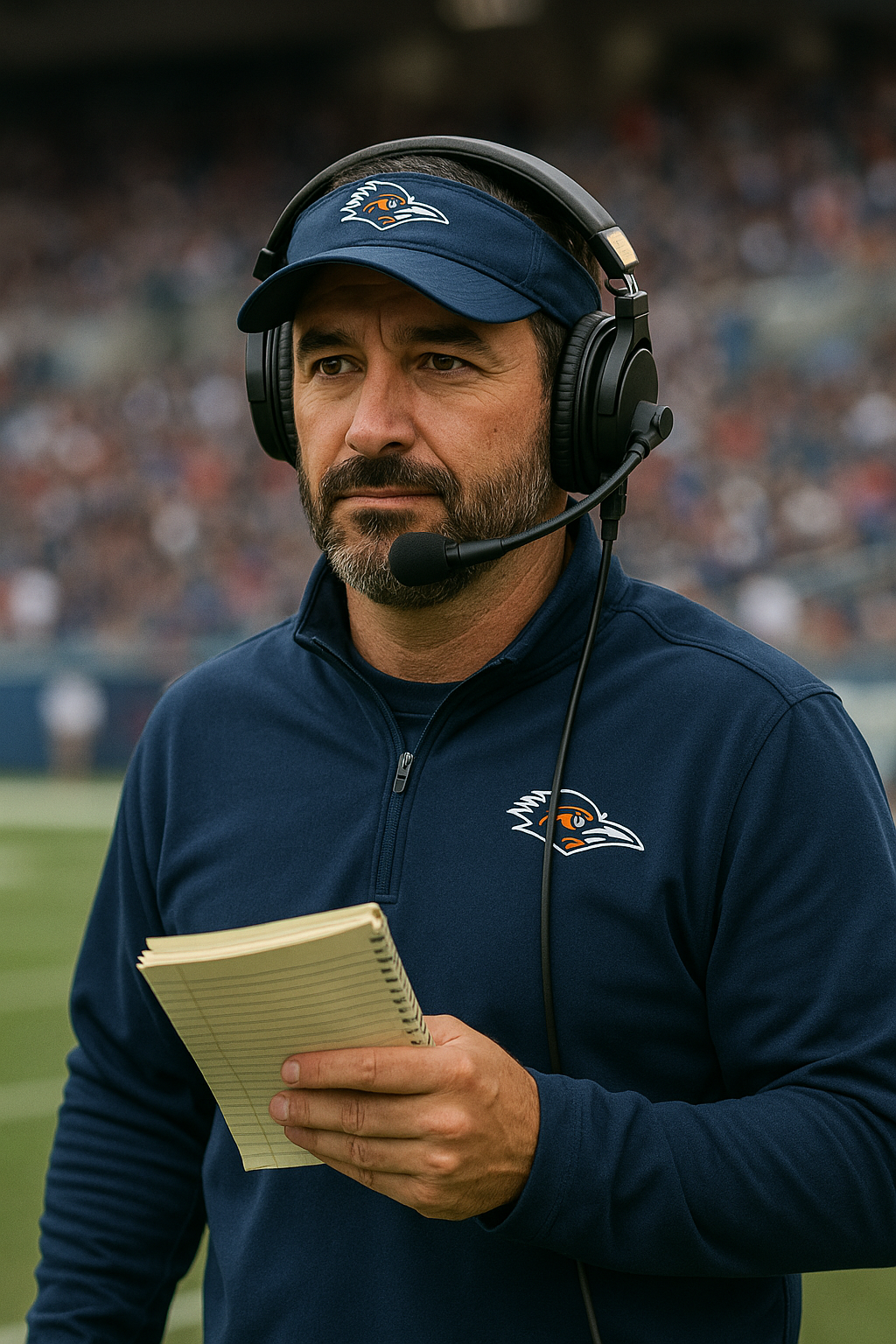
Frankie Calderón, better known across Texas airwaves as “The Horn,” is a no-nonsense football lifer with a sharp tongue and a soft spot for the underdog. Raised just outside of Pueblo, Colorado, Frankie cut his teeth covering JUCO ball and D2 programs before turning heads with his bold coverage of the Western Colorado Mustangs — and one fiery young coach named Clay Merritt.
When Merritt made the leap to UTSA, Frankie followed — not as a coach, but as the unofficial voice of the program, launching Runner Nation Radio and embedding himself in the culture of the team.
Fans love him. Opposing coaches fear him. And Stonewall? He respects the hell out of him.
College Football Chaos: Georgia Falls, Bama Breaks & Ohio State Survives | The Morning After Week 7