Freedom Fights, World Cup Nights & Festival Dreams: FeOTB Ep 279 Recap
Freedom Fights, World Cup Nights & Festival Dreams: FeOTB Ep 279 Recap
There are normal sports weekends, and then there are weekends where the calendar looks like it was booked by a 12-year-old with unlimited power, a patriotic playlist, and access to every major sports property in America.
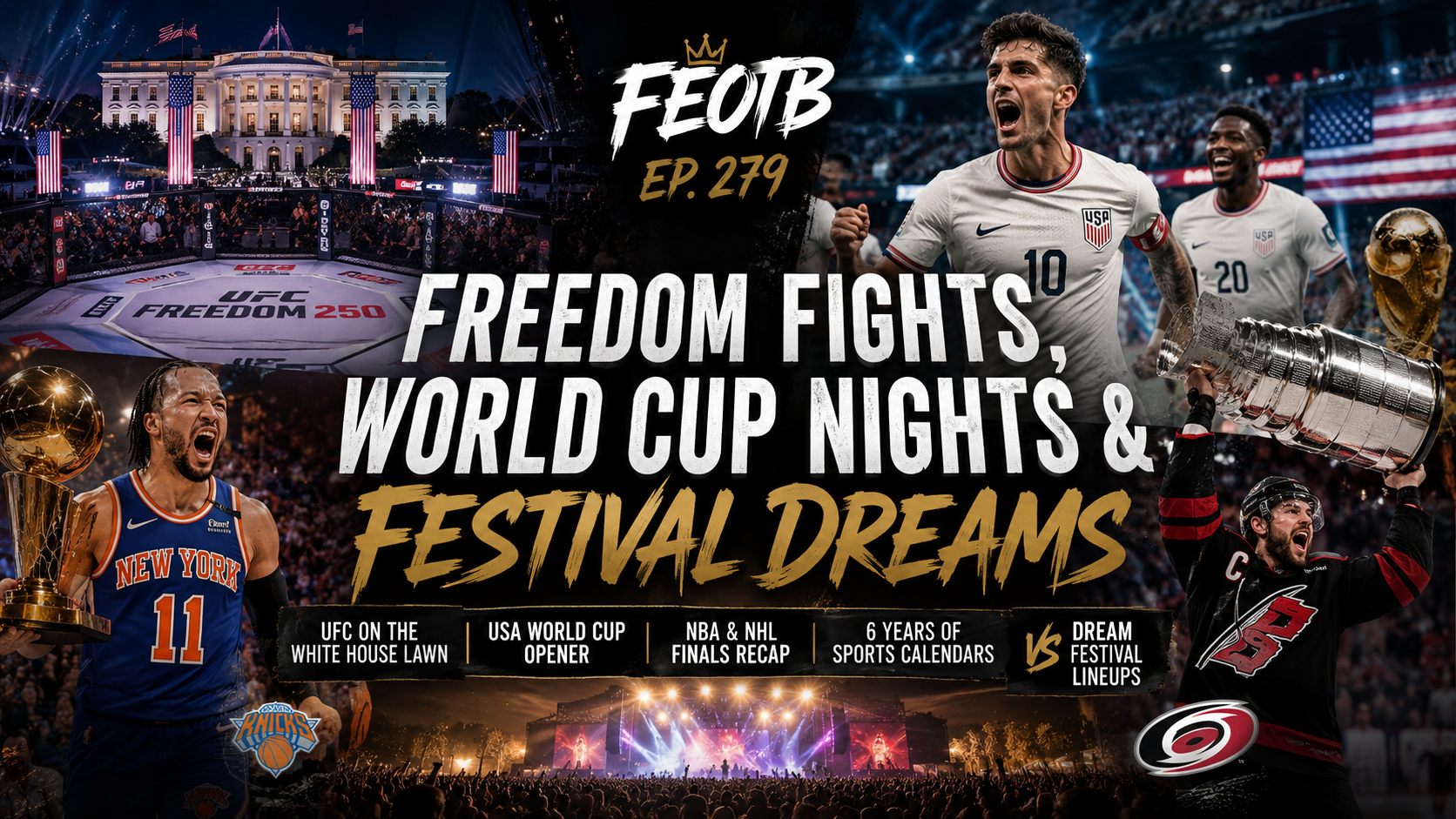
Episode 279 of The Far End of the Bench was one of those episodes where the title had to carry a lot of weight:
Freedom Fights, World Cup Nights & Festival Dreams.
That was not just a catchy name. That was the actual menu.
We had UFC Freedom on the White House lawn, the United States opening the World Cup on fire, both the NBA Finals and Stanley Cup Final coming to a close, the show officially turning the page on its sixth full sports calendar, and then the kind of VS segment that only makes sense in the summer: Niko and Jimmy building their dream five-act music festival lineups.
In other words, it was sports, spectacle, patriotism, nostalgia, arguments, awards, and a little bit of chaos. So basically, exactly what this show is supposed to be.
[Insert Episode 279 Thumbnail Here]
Alt text: Freedom Fights, World Cup Nights and Festival Dreams episode graphic featuring UFC, USA soccer, Knicks, Hurricanes and festival imagery.
UFC Freedom Turned the White House Lawn Into the Wildest Fight Venue in Sports
Let’s start with the thing that sounds fake even after seeing the pictures.
The UFC held a card on the White House lawn.
Not near the White House. Not in Washington D.C. with some patriotic branding slapped on the canvas. The actual South Lawn became a fight venue, complete with the Octagon, lights, walkouts, flyovers, national anthem energy, and the kind of visual that makes you stop scrolling even if you do not care about MMA.
This was the perfect opening topic for Episode 279 because it was impossible to talk about it like a normal fight card. You could hate the politics. You could love the politics. You could be completely exhausted by politics. But if you are being honest, the image of fighters walking out of the White House and into an Octagon on the lawn was objectively insane.
That was the point.
This was not subtle. It was not supposed to be. It was red, white, blue, loud, weird, over-the-top, and somehow still perfectly on brand for both UFC and America.
The show framed it the right way: not as a cable news segment, but as a sports spectacle. Because that is what it was. It was UFC meets WrestleMania meets Fourth of July meets “are we sure this is allowed?” energy.
And then the fights delivered.
The card had knockouts, shocks, and the kind of violent theater UFC dreams about when it builds a stage that big. Diego Lopes had the kind of image fighters wait their whole career for. Sean O’Malley got his salute moment. Ciryl Gane shocked people. Bo Nickal kept reminding everyone that being a wrestling specialist does not mean he is allergic to knocking people out.
But the story of the night was Justin Gaethje.
A Colorado-connected fighter, a lifelong action hero in a sport full of manufactured tough guys, Gaethje stepped into the biggest American propaganda movie ever made and somehow made the script even more ridiculous. A six-to-one underdog. A red, white and blue setting. A championship moment. A fighter who has built his career on never backing away from the worst possible damage.
That is not just a win. That is a sports movie.
Gaethje has always been the human highlight. Episode 279 captured why that nickname still matters. He is not just exciting because he throws hard. He is exciting because he fights like every second might be the last second anybody gets to watch him. He has ruined big future plans before. He has killed money fights before. He has stepped into the middle of UFC’s perfect little marketing machine and said, “Cool. What if I just beat the guy?”
That is what made this one feel so big.
At UFC Freedom, Gaethje was not just fighting for a belt. He became the face of the whole absurd, beautiful, ridiculous event.
The USMNT Opened the World Cup With Edge
After the White House lawn turned into a fight venue, the episode stayed on the American pride track with the United States men’s national team opening the World Cup.
This was not soft, cautious, “please respect us” soccer.
This was a team that came out with bite.
The conversation around the USMNT has been the same for years. Golden generation. Potential. Talent. European clubs. Big names. Big expectations. Then the tournament comes and everybody waits to see if the moment is going to swallow them.
Episode 279 did not treat the opener like some cute little participation trophy. The show leaned into what made it feel different: the U.S. played with a mean streak.
That matters.
There is a version of American soccer that tries so hard to prove it belongs that it forgets to be nasty. This team did not feel like that. The opener had pressure. It had aggression. It had the feeling of a team that was not just trying to survive a World Cup at home. It was trying to make somebody else uncomfortable.
That is where the Pochettino conversation gets interesting.
The tactics are going to be debated. The structure is going to be picked apart. The long-term ceiling is still unknown. But in the first match, the identity was clear: if the defense is going to be questioned, attack. If the opponent wants rhythm, disrupt it. If the world still sees the U.S. as a nice host nation, kick the ball into the corner and make them chase.
That is not always going to work against everybody. It probably cannot carry you through an entire tournament by itself. But for an opener, it was exactly the tone this team needed.
There was also a perfect contrast in the episode because Niko was coming off the live World Cup experience in Houston for Germany’s 7-1 win. That gave the show a full World Cup texture. It was not just box score talk. It was scarves, chants, fan festivals, humidity, sold-out merch, casual fans wanting goals, and the realization that when the World Cup is on American soil, the entire country becomes a sports carnival.
That is what makes this summer different.
This is not just the World Cup happening somewhere else while Americans check in every four years. This is the World Cup happening here. In our stadiums. In our cities. In the middle of our sports calendar. And if the U.S. plays with the edge it showed in the opener, casual fans are going to find a reason to care very quickly.
Jalen Brunson Became New York’s New Sports Icon
Then the show turned to the NBA Finals, and honestly, there is no way to talk about this Knicks title without making it bigger than basketball.
The New York Knicks winning the NBA Finals is not just a championship. It is a city-wide emotional release.
Knicks fans have lived through decades of jokes, bad rosters, false hope, dysfunction, and “maybe this is the year” turning into “never mind, everything is broken again.” So when Jalen Brunson dragged that franchise to the top of the league, the conversation had to shift.
Is he a superstar?
That question is over.
He is not just a superstar. He is now one of the faces of New York sports.
Episode 279 put it perfectly: once you win a title in New York, especially with the Knicks, you enter a different room. That room has names like Derek Jeter and Eli Manning floating around it. That does not mean every debate is clean. It does not mean Brunson has more total career weight than every legend in the city’s history. But it does mean his name is no longer just part of NBA talk.
He belongs to New York now.
The wild part is how the Knicks did it. This was not some smooth, dominant, wire-to-wire Finals performance. This was a team that kept getting punched, kept falling behind, kept looking like the moment was finally too much, and then kept finding a way back.
That is what makes Brunson the perfect guy for that city.
New York does not really want perfect. New York wants stubborn. New York wants tough. New York wants someone who looks at a bad situation and says, “Fine, we’ll do it the hard way.”
That is Brunson.
He was doubted. He was undersized. He was not supposed to become this. And now he is the guy who brought the Knicks back to the top of the NBA.
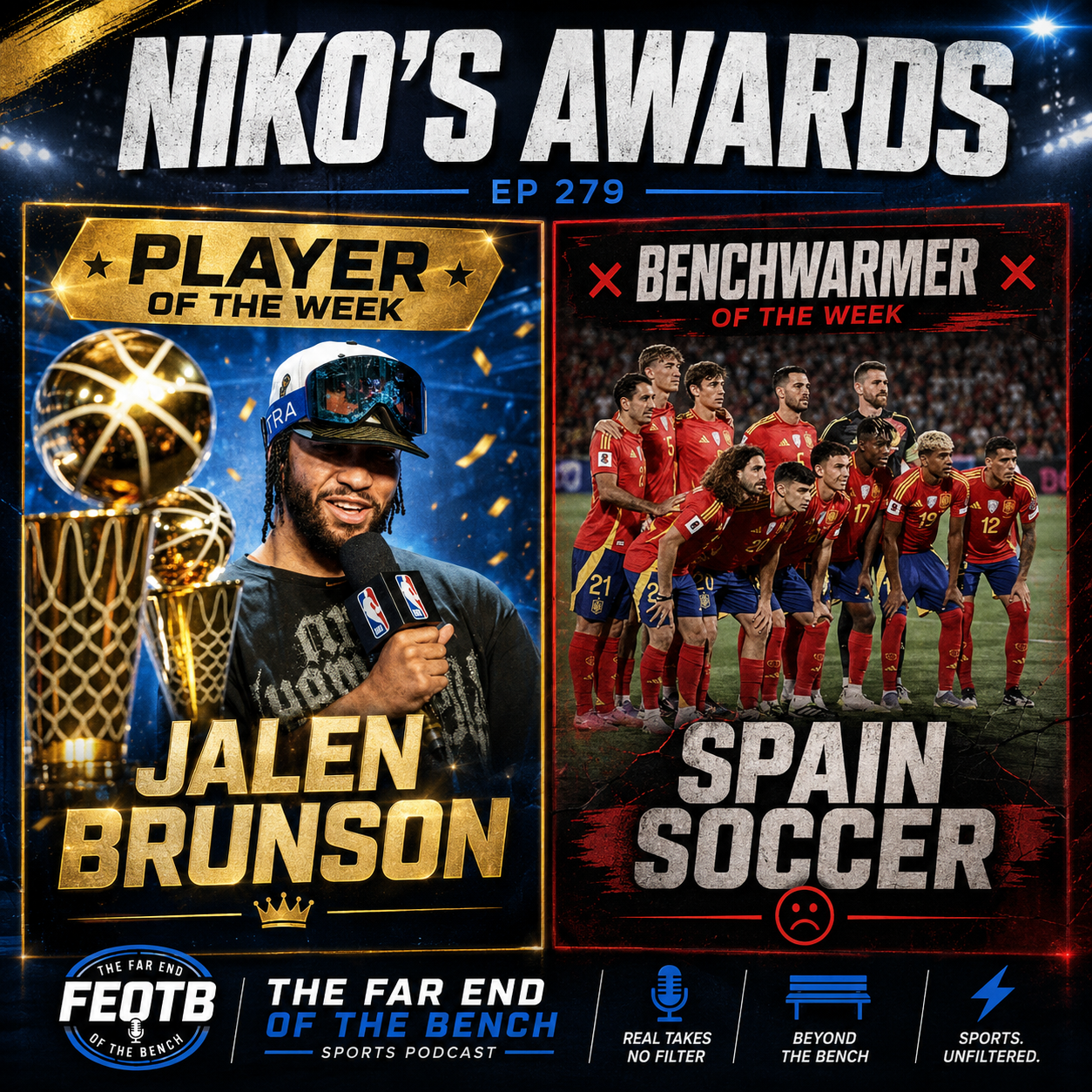
Niko’s Player of the Week graphic nailed it: Jalen Brunson with the trophy, gold everywhere, the whole thing feeling like a coronation. Because that is what it was.
[Insert Niko’s Awards Graphic Here]
Alt text: Niko’s awards graphic naming Jalen Brunson as Player of the Week and Spain Soccer as Benchwarmer of the Week.
Carolina Ended the “Almost Team” Conversation
On the hockey side, the Carolina Hurricanes finally finished the job.
For years, Carolina has been the team everybody respects but nobody fully fears in June. They play hard. They forecheck. They defend. They make life miserable. They win plenty of regular season games. Then the playoffs arrive, and eventually the conversation becomes, “Yeah, but can they actually get over the top?”
Now they can stop answering that question.
They won the Stanley Cup.
And they did it against Vegas, which made it even sweeter for Avalanche fans who have had to sit through years of “Vegas is built for the playoffs” discourse. Carolina did not beat Vegas by pretending to be something else. They beat Vegas by playing Hurricane hockey.
That was one of the best points from the episode. Every team that gives the Avalanche problems seems to have some version of that Carolina formula: pressure, depth, structure, pace, and a willingness to make every inch of the ice miserable.
Carolina did not just survive that style. They perfected it.
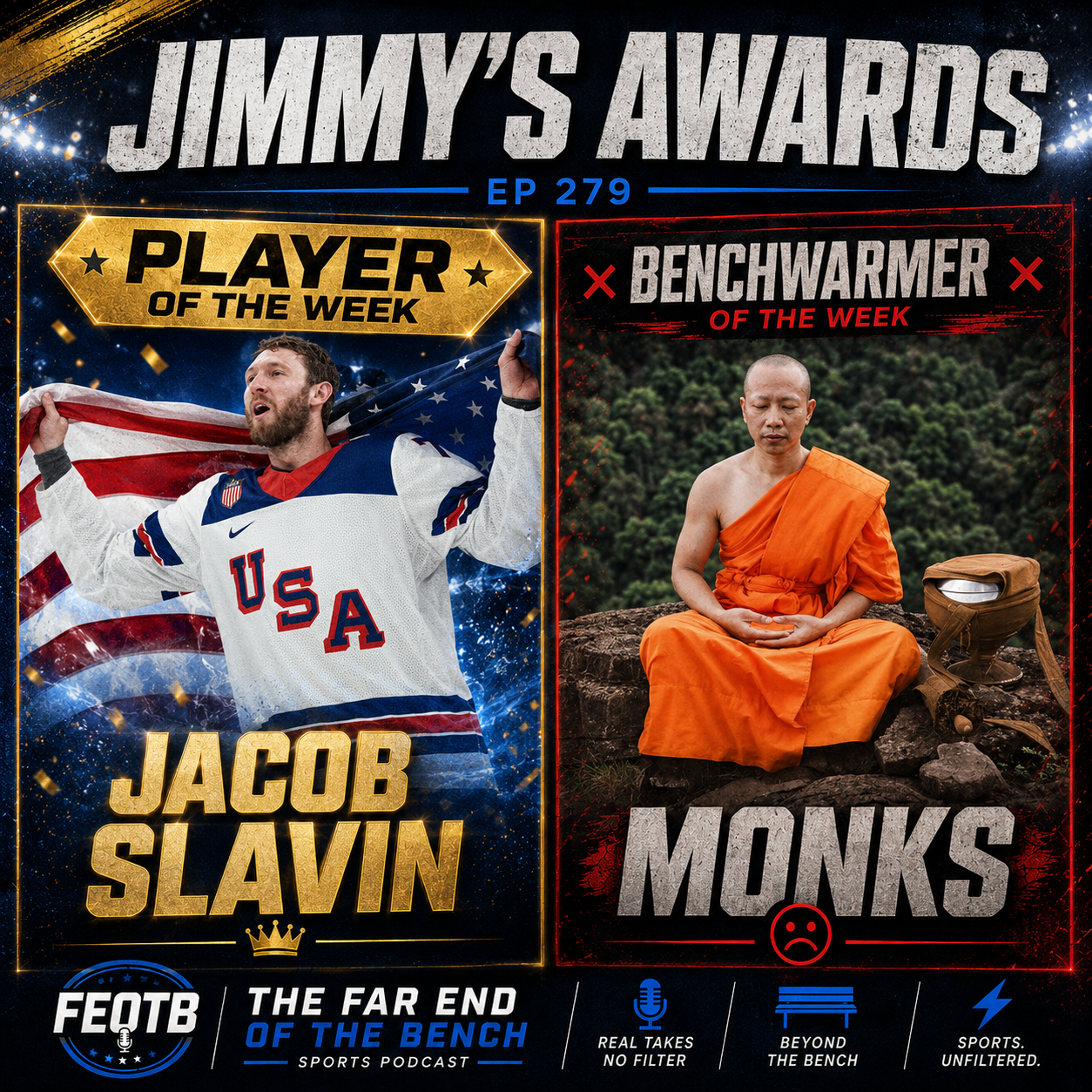
The episode also hit the local Colorado angle with Jacob Slavin, which made Jimmy’s awards graphic make perfect sense. Slavin is not the loudest star in hockey, but he is the kind of player championship teams are built around. Reliable, smart, steady, and now part of a Stanley Cup story that also connects back to Colorado.
That is a Player of the Week pick with layers.
[Insert Jimmy’s Awards Graphic Here]
Alt text: Jimmy’s awards graphic naming Jacob Slavin as Player of the Week and Monks as Benchwarmer of the Week.
Six Sports Calendars Later, the Show Is Still Standing
One of the most important parts of Episode 279 was not just the games. It was the reflection.
The show has now gone through six full sports calendars.
That means six cycles from football season into winter chaos, into March Madness, into playoff pushes, into the NBA Finals and Stanley Cup Final, into the strange summer stretch where sports gets weird and everybody starts arguing about lists.
That is not nothing.
For a weekly sports podcast, the calendar is more than a schedule. It becomes a measuring stick. You remember where you were when the Nuggets won. You remember the Avs Cup run. You remember the Broncos heartbreaks, the Bengals scars, the arguments that seemed huge for a week and then disappeared forever, and the moments that actually stuck.
That is what The Far End of the Bench has quietly become.
It is not just a show reacting to sports. It is a record of how sports marks time.
Every season, every championship, every draft, every Finals recap, every random summer VS segment becomes part of the story. Six calendars in, the show has enough history that the hosts are not just talking about what happened. They are talking about where they were when it happened.
That is the difference between content and a real show.
Content disappears. A real show builds a timeline.
Episode 279 felt like one of those timeline episodes.
Dream Festival Lineups: The Most Summer VS Segment Possible
After all the championships, fight cards and World Cup pressure, the episode needed something lighter. Enter the VS segment: dream five-act summer music festival lineups.
This is exactly the kind of segment that works because it is simple, personal, and instantly debatable.
Niko’s lineup:
- Brooks & Dunn
- Luke Combs
- Post Malone
- Frank Sinatra
- Elvis
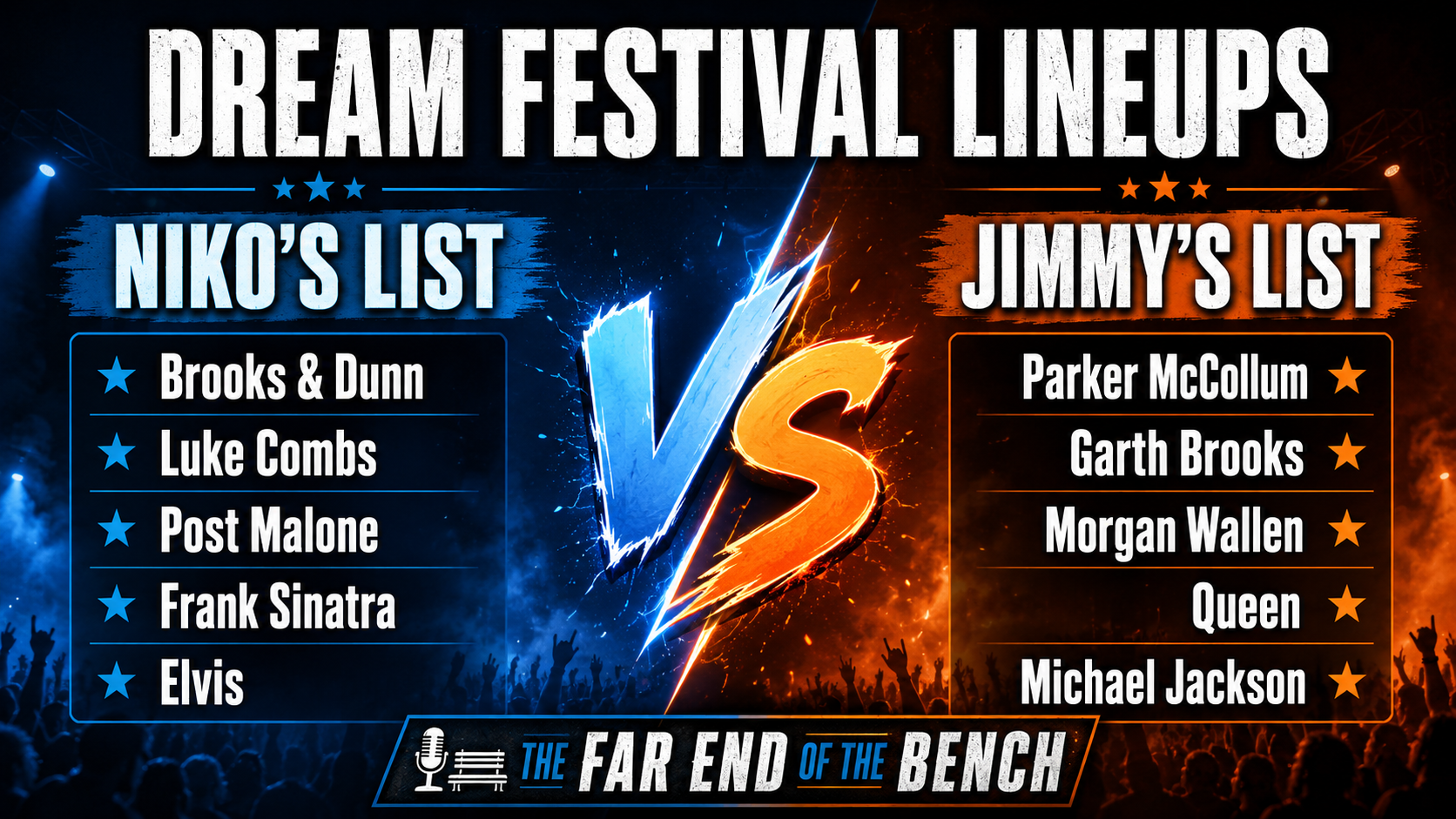
Jimmy’s lineup:
- Parker McCollum
- Garth Brooks
- Morgan Wallen
- Queen
- Michael Jackson
This is not just “pick five artists.” That would be too easy. The real question is who built the better festival.
Niko’s list has range. Brooks & Dunn sets the tone, Luke Combs brings the current country crowd, Post Malone gives you the crossover superstar, Sinatra gives it class, and Elvis gives it the all-time closing spectacle.
Jimmy’s list is built like a stadium takeover. Parker McCollum and Jon Pardi were the original country foundation, but swapping in Garth Brooks gives it nuclear headliner power. Morgan Wallen brings the modern streaming monster. Queen is a live-performance cheat code. Michael Jackson is the kind of closer that turns a festival into a global event.
This is why the VS segment works so well. There is no right answer, but everyone has an answer.
A person’s dream festival lineup tells you a lot about them. Are they chasing vibes? Are they chasing legends? Are they building a full weekend? Are they stacking headliners with no concern for emotional pacing? Are they trying to win the aux cord or sell out a stadium?
That is the debate.
[Insert VS Graphic Here]
Alt text: Dream Festival Lineups VS graphic with Niko’s lineup against Jimmy’s lineup.
Weekly Awards: Brunson, Slavin, Spain Soccer and Monks
The awards section brought the episode home with the usual mix of respect and ridicule.
Niko’s Player of the Week was the obvious one: Jalen Brunson. When you become the face of a Knicks championship, there is no need to overthink it. That is the award.
Niko’s Benchwarmer of the Week went to Spain Soccer, and honestly, that one had heat behind it. When you are supposed to be one of the elite teams in the world and you stumble against a country most casual fans could not find on a map, you earn the bench. That is the job.
Jimmy’s Player of the Week was Jacob Slavin, a perfect hockey pick and a perfect Colorado-connected pick. Stanley Cup champion, Team USA relevance, steady defenseman, and one of those players who does not need to scream for attention to deserve it.
Jimmy’s Benchwarmer of the Week went to Monks, which might be one of the most random-looking graphics out of context, but that is also part of the charm. The awards are supposed to be weird. They are supposed to be personal. They are supposed to make people ask, “Wait, how did we get here?”
That is the show.
Final Thoughts
Episode 279 worked because it did not try to be one thing.
It was a fight recap. It was a World Cup reaction. It was a Finals wrap-up. It was a look back at six years of sports calendars. It was a music festival argument. It was an awards show. It was patriotic, chaotic, funny, reflective, and occasionally completely unhinged.
That is the sweet spot for The Far End of the Bench.
The sports world gave us a White House UFC card, a fired-up USMNT, a Knicks championship, a Hurricanes breakthrough, and a summer festival debate all in the same episode window. The show did what it is supposed to do with a weekend like that: grab all of it, throw it on the table, and argue through the mess.
Because six sports calendars in, that is still the point.
If you do not stay down and you never quit, come sit on the far end of the bench.
Watch Episode 279 on YouTube and listen wherever you get your podcasts.

Co-Host
Jimmy Pallotto - Co-Host, The Far End of the Bench
Born and raised in the heart of Colorado, Jimmy Pallotto is the passionate voice behind The Far End of the Bench. A lifelong sports enthusiast, Jimmy brings unparalleled energy, humor, and insight to the podcast, combining his deep-rooted love for the game with a sharp analytical edge. As a proud alumnus of Western Colorado University, where he majored in Communication Arts and Sociology, Jimmy’s background equips him to deliver thoughtful commentary and engage in meaningful discussions with fans and guests alike.
Jimmy’s love for sports extends beyond the mic. By day, he’s shaping young minds as a 7th-grade social studies teacher and multi-sport coach, mentoring athletes in wrestling and football. A dedicated coach and educator, Jimmy instills the same values of teamwork, leadership, and dedication in his students that he shares on the podcast.
When he's not in the classroom or recording episodes, Jimmy enjoys spending time with his girlfriend Carlye, their energetic Border Collie Boomer, and his close-knit family. Whether he's breaking down game-winning plays, sharing hilarious locker room stories, or diving deep into the latest sports controversies, Jimmy’s vibrant personality and authentic voice make him a fan favorite.
Catch Jimmy every week on The Far End of the Bench, where he and his co-host Niko Bryant tackle everything from Colorado sports to national headlines, bringing the sidelines to center stage.
The Morning After — Week 2: Stillwater Shock, Michigan Muscle, Texas’ Miracle & Border War Bad Blood