McGregor Meltdown, World Cup Final Four and NFL QB Ranking Wars | FEOTB Episode 282
There are bad performances.
There are disappointing performances.
Then there is building an entire UFC card around the return of Conor McGregor—only for the biggest star in company history to throw approximately one-and-a-half kicks, collapse with a torn ACL and bring the entire main event to an end after 69 seconds.
That was not a comeback.
That was an expensive appointment television commercial for disappointment.
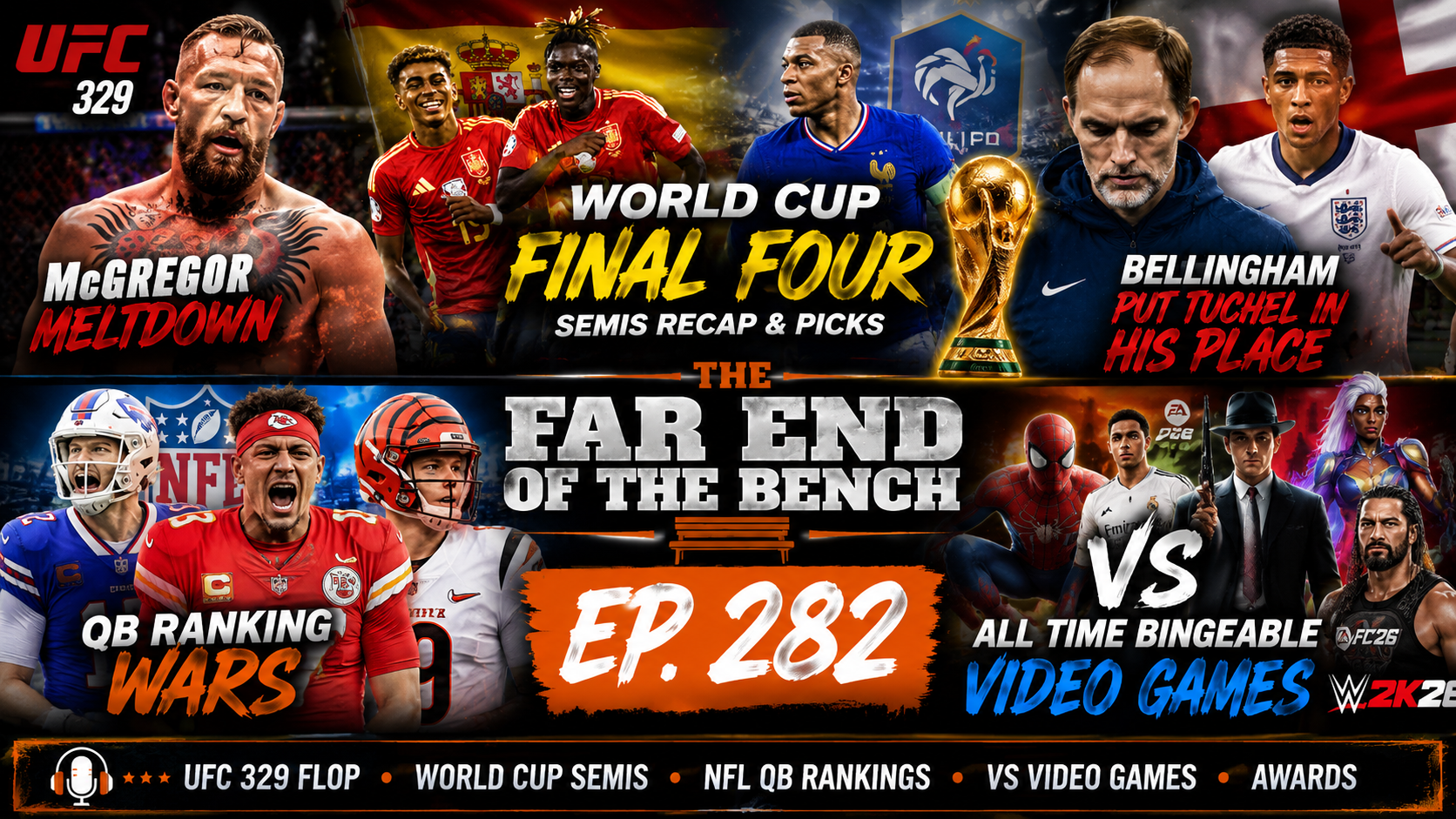
On The Far End of the Bench Episode 282, Niko and I break down the McGregor meltdown, the stars UFC 329 nearly buried beneath it, the World Cup’s Final Four, Jeremy Fowler’s controversial NFL quarterback rankings and the video games capable of swallowing an entire summer break.
We also hand out our Players and Benchwarmers of the Week, with Spain, Jude Bellingham, Thomas Tuchel and McGregor all receiving very different kinds of recognition.
Welcome to the Far End of the Bench.
Let’s get into it.
Conor McGregor’s UFC 329 Return Was a Historic Flop
The worst part about McGregor’s return was not that the fight ended quickly.
Combat sports always carry that risk. A boxing match can end with one punch. An MMA fight can end with one submission, one head kick or one unfortunate injury.
The problem was everything surrounding this particular ending.
McGregor had not fought in years. He had not won a fight in even longer. Yet UFC 329 was promoted as the resurrection of the man who once turned every press conference, weigh-in and walk to the Octagon into a global event.
Then the bell rang.
McGregor threw a couple of kicks, went down with an injury and left everyone staring at the screen wondering whether the main event had actually begun.
It had.
It was also already over.
Fans did not tune in hoping to watch a nearly 40-year-old fighter’s body betray him. They wanted to know whether any piece of “Mystic Mac” remained beneath the movie roles, controversies, inactivity and endless promises of a comeback.
Instead, they received confirmation that time is undefeated.
McGregor’s body was not being asked to perform on a movie set. There were no second takes, stunt doubles or special effects waiting to rescue the scene. He was returning to a sport in which another human being was preparing to punch, kick and drag him through five rounds of violence.
The ACL went first.
There was no guarantee the rest of him would have survived much longer.
Niko and I both would have preferred a definitive answer. Let Max Holloway test McGregor’s chin. Let the fight reveal whether the timing, power and instincts were still there. Even a decisive McGregor loss would have told us more than the ending we received.
Instead, UFC 329 gave us 69 seconds of nothing and another rehabilitation timeline.
McGregor has reportedly remained adamant that he will complete the final fight on his contract after surgery. But after this ending, the question is no longer whether he can become champion again.
The question is whether anybody should still build a major event around him.
The McGregor discussion begins with the main event’s abrupt ending, the disappointment surrounding his return and the effect it had on viewers who tuned in specifically to see him fight.
The Death of the UFC Pay-Per-View Superstar
McGregor’s collapse exposed a larger problem for the UFC.
He may have been its final true pay-per-view superstar.
The company no longer needs an individual fighter to sell an event in quite the same way it once did. Its distribution model provides guaranteed money and puts major cards in front of a broader subscription audience.
From a business perspective, that security makes sense.
From a star-building perspective, it may be killing the thing that made UFC events feel essential.
Chuck Liddell felt larger than the sport.
Georges St-Pierre felt larger than the sport.
Jon Jones, Ronda Rousey and McGregor could convince casual viewers to rearrange their entire weekend around a fight.
McGregor became the ultimate version of that attraction. Even people who could not name three UFC champions knew when he was fighting.
Now, look around the promotion.
Alex Pereira remains a major attraction, but he is not getting younger. Jones is nearing the end. Justin Gaethje has openly approached the retirement conversation. Holloway has already given the company years of unforgettable fights. Paddy Pimblett has personality and momentum, but even he is not a brand-new prospect.
The UFC has talented fighters.
It has champions.
It has contenders.
What it does not have is an obvious answer to the question: Who headlines UFC 350 or UFC 400 and makes the entire sports world care?
The promotion’s current structure may have removed some of the financial urgency to answer that question. The event gets distributed. The rights payment arrives. The machine keeps moving.
But guaranteed distribution cannot manufacture emotional investment.
The UFC still needs personalities, rivalries and fighters capable of making a random person text a friend and say, “Turn this on right now.”
That is how combat sports grow.
The podcast’s concern was not merely that one McGregor event failed. It was that UFC 329 symbolized the fading of the company’s last true pay-per-view attraction while no clear successor waits behind him.
UFC 329 Had Stars—McGregor’s Meltdown Nearly Buried Them
Here is what makes the main-event disaster even more frustrating:
The rest of UFC 329 gave the promotion reasons to feel hopeful.
Paddy Pimblett Proved He Can Remain Near the Top
Pimblett entered the event needing to show that his momentum had not disappeared after his loss to Gaethje.
He did exactly that.
Whatever anyone thinks of his personality, presentation or ceiling, Paddy understands how to hold attention. People react to him. They either want to see him win or desperately want to watch someone shut him up.
Both reactions sell fights.
That does not automatically make him the next McGregor. It does, however, make him one of the few current UFC fighters who understands that being technically impressive is only part of the job.
Fans need a reason to care before the cage door closes.
Paddy gives them one.
Gable Steveson Has Everything the UFC Claims It Wants
Then there is Gable Steveson.
Olympic gold medalist.
One of the greatest American heavyweight wrestlers ever produced.
A freak athlete with the size and strength to make elite competition look ordinary.
He also does not speak like someone who plans to quietly collect decision victories and disappear backstage.
Steveson already understands promotion. He can talk. He can create future matchups. He carries the credibility of a legitimate wrestling résumé, while training around names such as Brock Lesnar and Jon Jones gives him another layer of combat-sports intrigue.
That does not mean he should be rushed.
The fastest way to ruin a potential superstar is to treat potential as a finished product.
But Steveson offers something rare: a genuine athletic foundation, a recognizable name and enough personality to make people interested before he has built a lengthy UFC résumé.
He is not McGregor’s replacement.
He may be part of the answer to what comes next.
The card left both hosts eager to watch Pimblett and Steveson again, even though the failed main event damaged the overall impression of UFC 329.
Spain Did Not Beat France—Spain Suffocated France
The World Cup semifinal between Spain and France looked like a heavyweight collision on paper.
France had the terrifying collection of attacking talent.
Kylian Mbappé.
Ousmane Dembélé.
Michael Olise.
Bradley Barcola.
Désiré Doué.
That is not an attack. That is a list of players designed to make defenders reconsider their career choices.
Then Spain made all of them disappear.
France’s individual talent never became collective danger because Spain refused to allow the match to develop at France’s preferred speed. Spain controlled possession, compressed the usable space and repeatedly forced France’s attackers into areas where they could not create clean opportunities.
Every French possession felt rushed.
Every attempted transition met another red shirt.
Every promising attack ran into a team that remained connected from the front line through the midfield and into the defense.
That is what makes Spain so difficult to beat. The possession is not decorative. It is defensive pressure disguised as patience.
When Spain controls the ball, the opponent cannot attack.
When Spain loses it, the nearest players immediately close the escape routes.
When the opposition finally wins enough space to look forward, it is often too tired or too disorganized to take advantage.
France entered the match with more than enough firepower to win the World Cup.
Spain took away the oxygen.
Belgium remained the only team to score against Spain during the tournament at the time of our recording. That defensive record was not built by sitting deep and praying. It was created through positioning, composure and a team-wide commitment to controlling every phase of the match.
Spain did not simply survive France.
Spain made France play a game it did not want to play.
That is why Jimmy’s Player of the Week was not one individual.
It was the entire Spanish national team.
The episode praised Spain’s defensive structure, possession and ability to neutralize France’s loaded attack, including Mbappé, Dembélé and the rest of its attacking group.
Argentina vs. England Was Never Just Another Football Match
Some World Cup matchups carry history.
Argentina versus England carries baggage.
The Hand of God.
The Goal of the Century.
Decades of football arguments.
National pride.
Political history.
The Falklands War.
When these teams meet, the match exists on more than one level. The current players inherit stories that began before many of them were born.
That is why the semifinal felt so enormous.
England entered with Jude Bellingham becoming more influential by the match, Harry Kane leading the attack and a tournament path that forced the team to survive difficult opponents and miserable conditions.
Argentina entered with Lionel Messi, Julián Álvarez, Lautaro Martínez and Emiliano Martínez—the goalkeeper whose penalty heroics helped deliver the 2022 World Cup.
On one side stood an England team attempting to prove that its current generation could finally convert talent into the country’s first World Cup title since 1966.
On the other stood an Argentina team attempting to become the first repeat champion since Brazil accomplished the feat in 1962.
It was star power, history and unresolved hostility compressed into 90 minutes.
That is what the World Cup does better than any other sporting event. A semifinal is never merely a semifinal. It becomes a collision between generations, national identities and moments people have argued about for decades.
The episode framed Argentina–England as a rivalry carrying both football history and wider geopolitical weight, with Messi, Kane and Bellingham adding modern star power to the matchup.
Jude Bellingham Put Thomas Tuchel in His Place
Thomas Tuchel became Jimmy’s Benchwarmer of the Week because this England run increasingly felt like a team succeeding beyond the limitations of its manager.
There are moments when tactics decide a match.
There are other moments when an extraordinary player refuses to let the tactics decide it.
Jude Bellingham became that player for England.
Two goals.
An extra-time hero.
A place in the semifinal.
Bellingham did not merely fill a position. He took control of the emotional center of the team.
That matters because England has spent years producing elite individual talent without always creating a team capable of surviving the moments when a major tournament becomes uncomfortable. Bellingham appears built for those moments.
He wants the ball when the stadium tightens.
He wants the responsibility when the match stops following the script.
He carries himself like the pressure belongs to everyone else.
Tuchel may receive credit for England’s placement, but Bellingham provided the moment. The player became bigger than the plan, and when that happens, the manager needs to recognize who is truly steering the team.
That is why the award graphic says it perfectly:
The game outcoached. The moment outshined.
Jeremy Fowler’s NFL Quarterback Rankings Started a War
There is no peaceful way to rank NFL quarterbacks.
Somebody will be too high.
Somebody will be too low.
A fanbase will feel personally insulted.
A radio host will spend four hours yelling about it.
Jeremy Fowler’s annual quarterback rankings delivered exactly the type of chaos we needed during the quietest portion of the NFL calendar.
The top three were:
- Josh Allen
- Patrick Mahomes
- Matthew Stafford
Then came the placement that immediately created the argument:
Joe Burrow at No. 4.
Burrow has already shown that he can take Cincinnati to a Super Bowl. He has gone into Arrowhead Stadium and beaten Mahomes in the postseason. When healthy, he is one of the most accurate, composed and dangerous quarterbacks in football.
The primary case against him is availability.
That concern is legitimate.
But ranking Burrow fourth still feels like punishing him for the failures surrounding him. Cincinnati’s defense, offensive line and organizational decisions have repeatedly made his job more difficult than it should be.
Then Lamar Jackson landed at No. 5.
Dak Prescott came in at No. 6, which produced the first true record-scratch moment of the list.
Dak is a good quarterback. At times, he has played like an excellent regular-season quarterback.
But No. 6 means placing him ahead of quarterbacks who have either produced greater postseason success or possess a ceiling that feels more capable of changing an entire franchise.
That is where these rankings always become complicated.
Are we ranking the quarterback we would choose for one game?
One season?
The next five years?
A September matchup?
A fourth-quarter playoff drive?
Those are completely different questions.
Fowler’s top four placed Allen, Mahomes and Stafford ahead of Burrow, while the episode immediately questioned Burrow’s placement and Prescott’s appearance at No. 6.
Why Joe Burrow at No. 4 Feels Disrespectful
Here is my issue:
There may not be another quarterback in football asked to overcome more dysfunction than Burrow.
The protection has failed him.
The defense has failed him.
The Bengals have allowed contract situations and roster holes to turn championship windows into weekly survival tests.
Yet when Burrow is healthy, Cincinnati remains dangerous because he gives the franchise an answer at the most important position in American sports.
Allen deserves to be in the top tier.
Mahomes remains Mahomes, regardless of how anyone weighs the previous season.
Stafford’s arm talent, experience and recent performance justify enormous respect.
But Burrow has already demonstrated that he can defeat the best quarterbacks in the most hostile environments. His problem is not whether he belongs among the elite.
His problem is whether Cincinnati can keep him upright long enough to prove it again.
Putting him fourth is defensible.
It still feels disrespectful.
Both things can be true.
The Most Bingeable Video Games of All Time
The VS debate took us away from torn ACLs, tactical structures and quarterback outrage and returned us to one of the purest joys of summer:
Losing an entire day to a video game.
Not every great game is bingeable.
Some games are masterpieces that require emotional preparation.
Others are games you can turn on at 9 a.m., look away from the screen and discover that the sun has gone down, you have skipped two meals and your controller battery is begging for mercy.
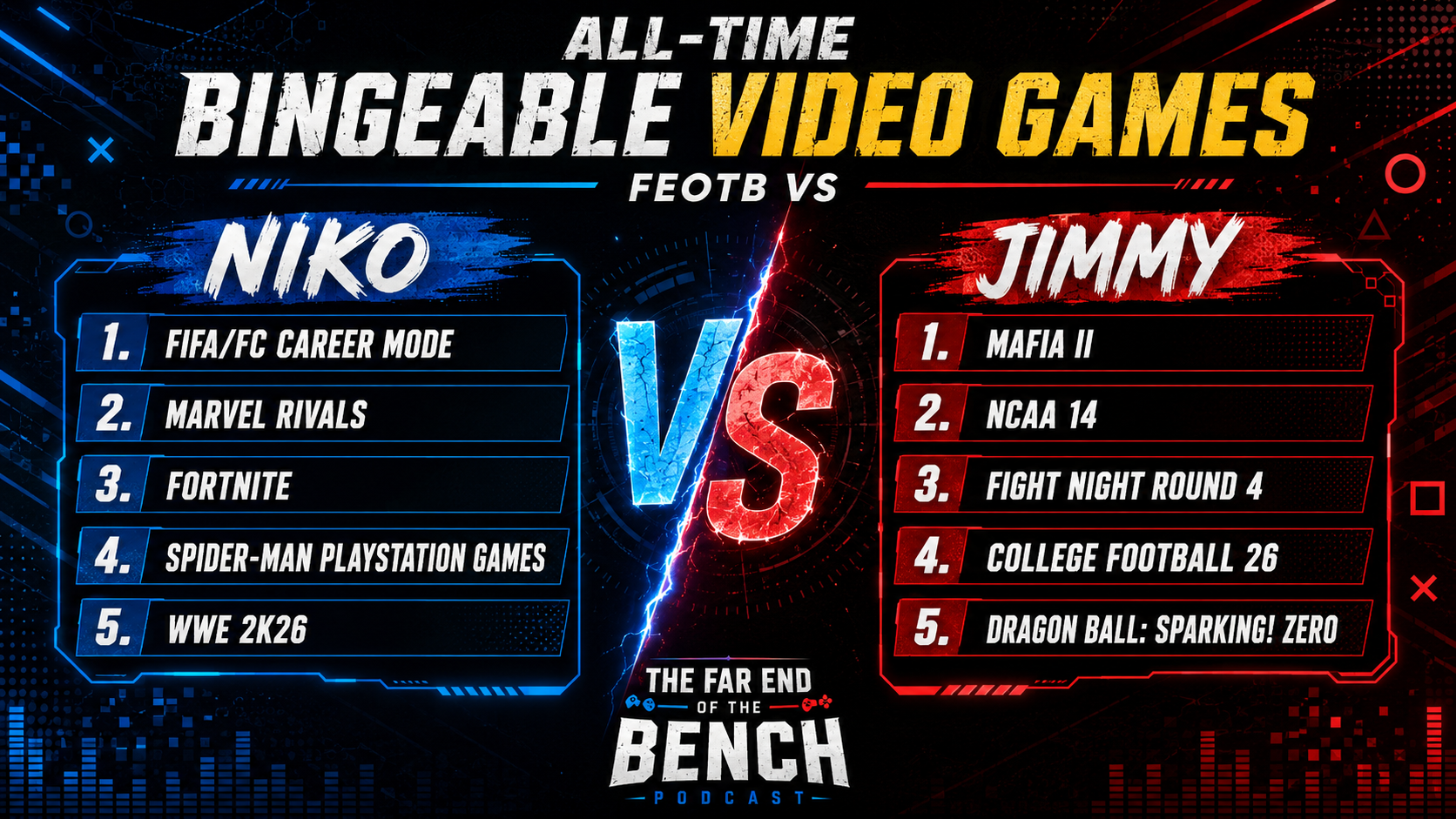
For this week’s debate, Niko and I selected our five favorite all-time video games to binge over summer break.
We somehow produced two completely different lists.
Niko’s Most Bingeable Video Games
- FIFA/EA Sports FC Career Mode
- Marvel Rivals
- Fortnite
- Spider-Man PlayStation Games
- WWE 2K26
Niko’s list is built around replayability.
Career Mode can consume months because there is always another transfer window, academy prospect or club rebuild waiting.
Marvel Rivals and Fortnite create the “one more match” trap that has destroyed responsible bedtimes for an entire generation.
The Spider-Man games provide the cinematic story and fluid combat that make completing every side mission feel worthwhile.
WWE 2K26 adds the customization, career storytelling and fantasy booking that allow players to create an entire wrestling universe.
Jimmy’s Most Bingeable Video Games
- Mafia II
- NCAA Football 14
- Fight Night Round 4
- College Football 26
- Dragon Ball: Sparking! Zero
My list is built around stories, nostalgia and worlds that become personal.
Mafia II remains one of my favorite story-driven experiences because Empire Bay feels alive, the characters feel human and the final betrayal still hurts after the screen goes dark.
NCAA Football 14 is not merely a football game. It is a time capsule. Dynasty mode turned random recruits into legends and made fictional seasons feel more important than some real ones.
Fight Night Round 4 delivered the type of boxing gameplay that the sports-gaming industry still has not properly replaced.
College Football 26 helped create Rise of the Roadrunners, giving me a reason to combine gameplay, storytelling, commentary and writing into something much larger than a standard dynasty save.
Then there is Dragon Ball: Sparking! Zero, which allows me to enjoy the universe I love—right up until an 11-year-old online opponent launches me across the screen for an entire match without allowing me to land one attack.
College Football 26 earned its place partly because it helped inspire the Rise of the Roadrunners series and expanded a normal dynasty into a larger creative project.
Mafia II Remains the Ultimate Summer Story Game
There are technically larger games than Mafia II.
There are games with bigger maps, more side missions, deeper customization systems and hundreds of additional hours of content.
I do not care.
Few games have ever made me feel more connected to a setting and its characters.
Mafia II understands that a compelling open world is not measured by the number of icons covering the map. It is measured by whether the player believes in the world.
Empire Bay changes with the seasons.
The music changes.
The cars change.
The neighborhoods feel different depending on where Vito’s story has taken him.
Most importantly, the game builds relationships that make its final mission hurt.
The betrayal works because the game convinces you that loyalty matters. It allows you to laugh with these characters, survive with them and believe there may be some version of a happy ending waiting at the end of the road.
Then the door closes.
The car turns away.
And the game reminds you that this life was never designed to reward loyalty.
That is why Mafia II remains my No. 1 bingeable game.
Not because it takes the longest to complete.
Because every time I return, I know exactly how the story ends—and some part of me still hopes it changes.
Players and Benchwarmers of the Week
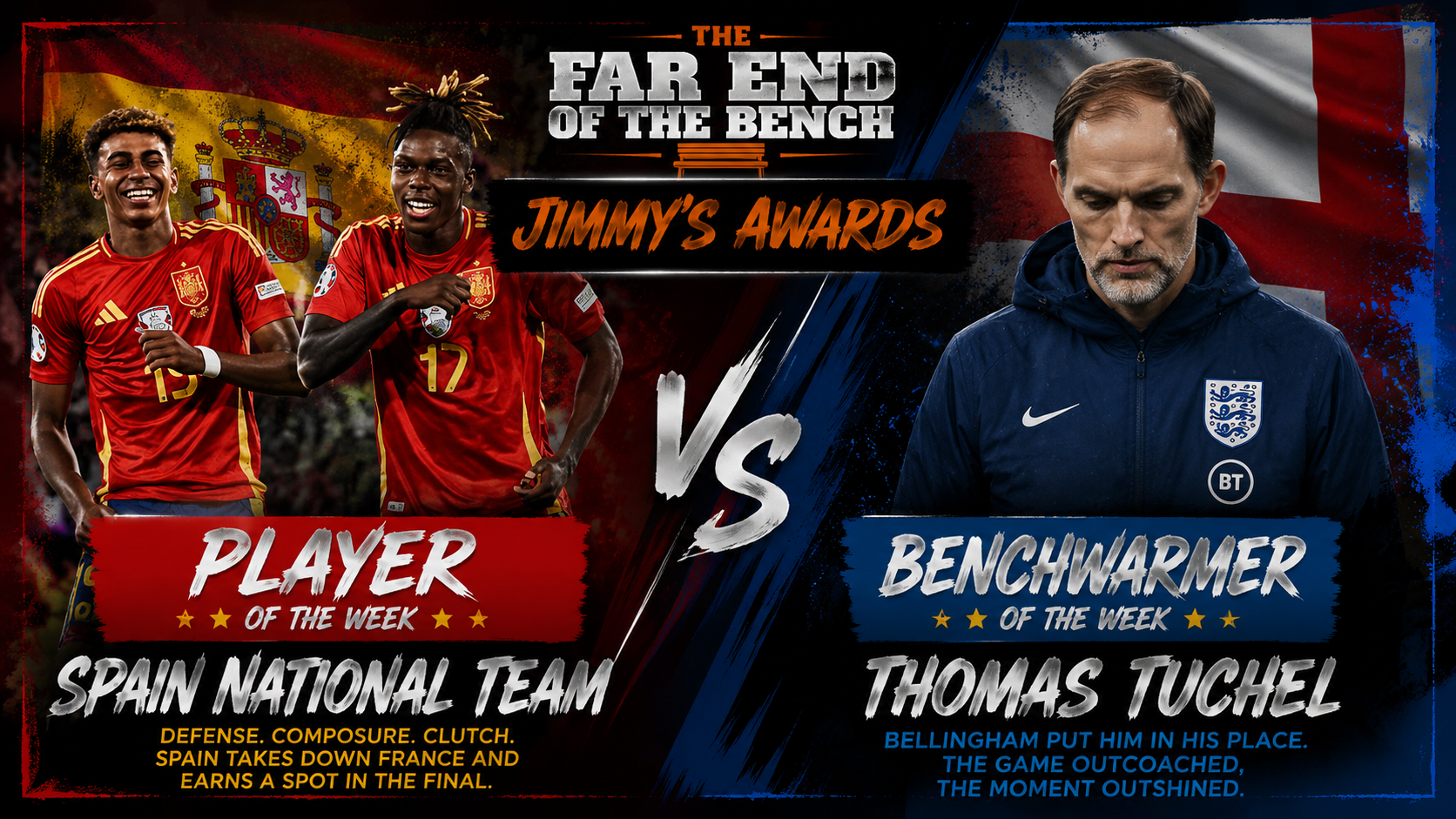
Jimmy’s Player of the Week: Spain National Team
Defense.
Composure.
Clutch execution.
Spain took one of the most frightening collections of attacking talent in the tournament and made France look ordinary.
The Spanish national team did not rely on one isolated moment of brilliance. It controlled the structure of the entire match and earned its place in the World Cup final.
Jimmy’s Benchwarmer of the Week: Thomas Tuchel
England reached the semifinal, but Jude Bellingham increasingly felt like the person dragging the team through its defining moments.
When the player has to transcend the manager’s plan, the player deserves the praise.
Tuchel gets the Benchwarmer.
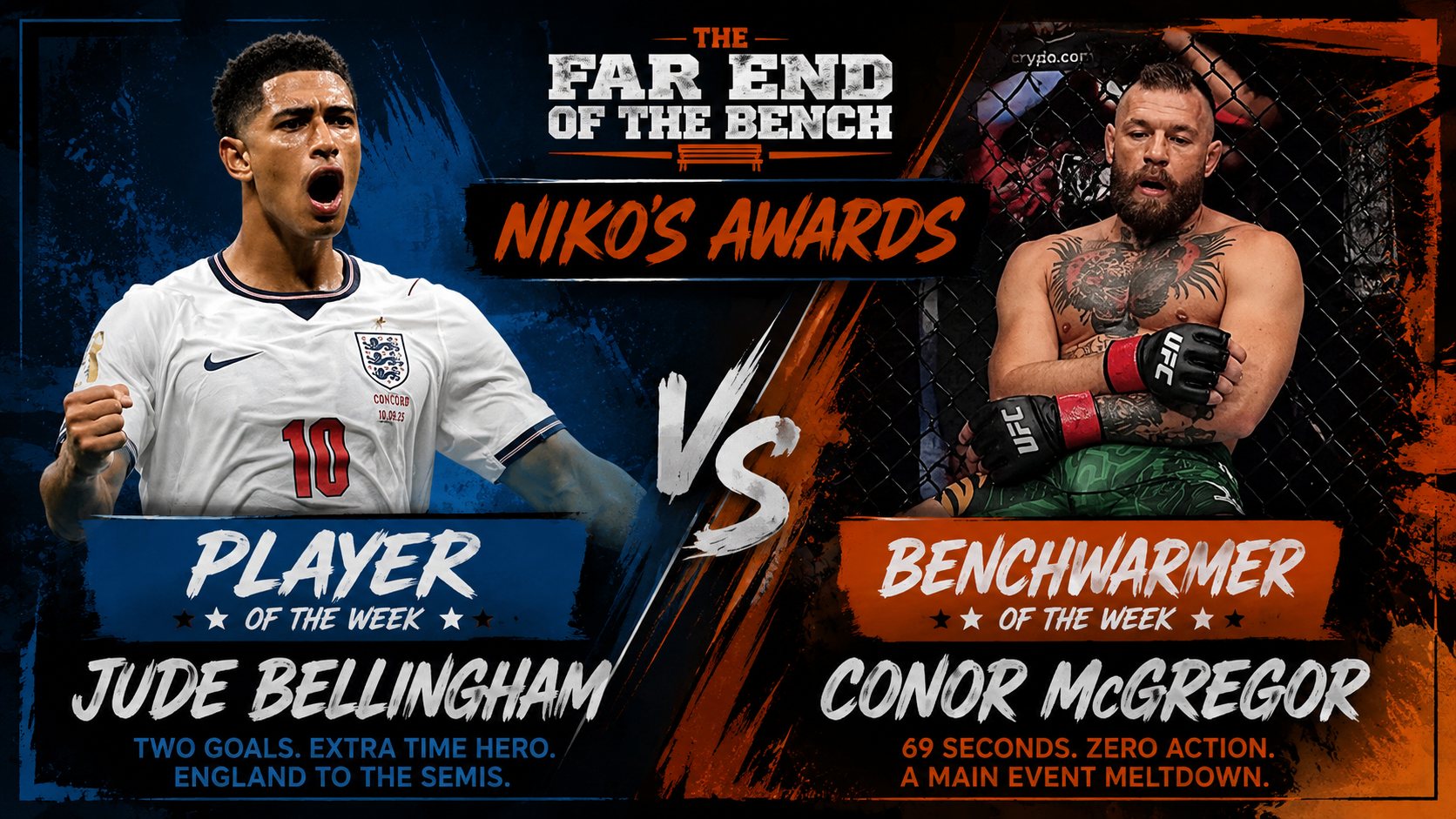
Niko’s Player of the Week: Jude Bellingham
Two goals.
Extra-time heroics.
England into the semifinals.
Bellingham delivered when his country needed someone willing to own the pressure.
Niko’s Benchwarmer of the Week: Conor McGregor
Sixty-nine seconds.
Zero action.
A main-event meltdown.
No further explanation required.
Final Whistle
Episode 282 began with the collapse of the UFC’s biggest star and ended with the video games that made us forget what time it was.
In between, Spain delivered a tactical masterclass, Argentina and England carried decades of history into a World Cup semifinal, Jude Bellingham continued becoming the center of England’s future and another quarterback ranking reminded everyone that NFL arguments never require an actual football game.
That is the beauty of the Far End of the Bench.
One moment, we are discussing the business consequences of McGregor’s broken-down comeback.
The next, we are explaining why Mafia II can emotionally damage a person more than a real sporting event.
The bench covers everything.
And there is always room at the far end.
Watch or listen to The Far End of the Bench Episode 282 and tell us:
Is Conor McGregor finished as a legitimate main-event attraction?
Was Spain’s performance the best tactical display of the World Cup?
Is Joe Burrow really only the fourth-best quarterback in football?
And whose bingeable video-game list wins the debate—Niko’s or Jimmy’s?

Co-Host
Jimmy Pallotto - Co-Host, The Far End of the Bench
Born and raised in the heart of Colorado, Jimmy Pallotto is the passionate voice behind The Far End of the Bench. A lifelong sports enthusiast, Jimmy brings unparalleled energy, humor, and insight to the podcast, combining his deep-rooted love for the game with a sharp analytical edge. As a proud alumnus of Western Colorado University, where he majored in Communication Arts and Sociology, Jimmy’s background equips him to deliver thoughtful commentary and engage in meaningful discussions with fans and guests alike.
Jimmy’s love for sports extends beyond the mic. By day, he’s shaping young minds as a 7th-grade social studies teacher and multi-sport coach, mentoring athletes in wrestling and football. A dedicated coach and educator, Jimmy instills the same values of teamwork, leadership, and dedication in his students that he shares on the podcast.
When he's not in the classroom or recording episodes, Jimmy enjoys spending time with his girlfriend Carlye, their energetic Border Collie Boomer, and his close-knit family. Whether he's breaking down game-winning plays, sharing hilarious locker room stories, or diving deep into the latest sports controversies, Jimmy’s vibrant personality and authentic voice make him a fan favorite.
Catch Jimmy every week on The Far End of the Bench, where he and his co-host Niko Bryant tackle everything from Colorado sports to national headlines, bringing the sidelines to center stage.
THE MORNING AFTER — WEEK 6: Texas Stunned, Georgia Takes the Throne & Oregon Implodes