Messed Around and Almost Found Out: No. 8 UTSA Survives Its Worst Performance in Two Years, Escapes Charlotte 38–17
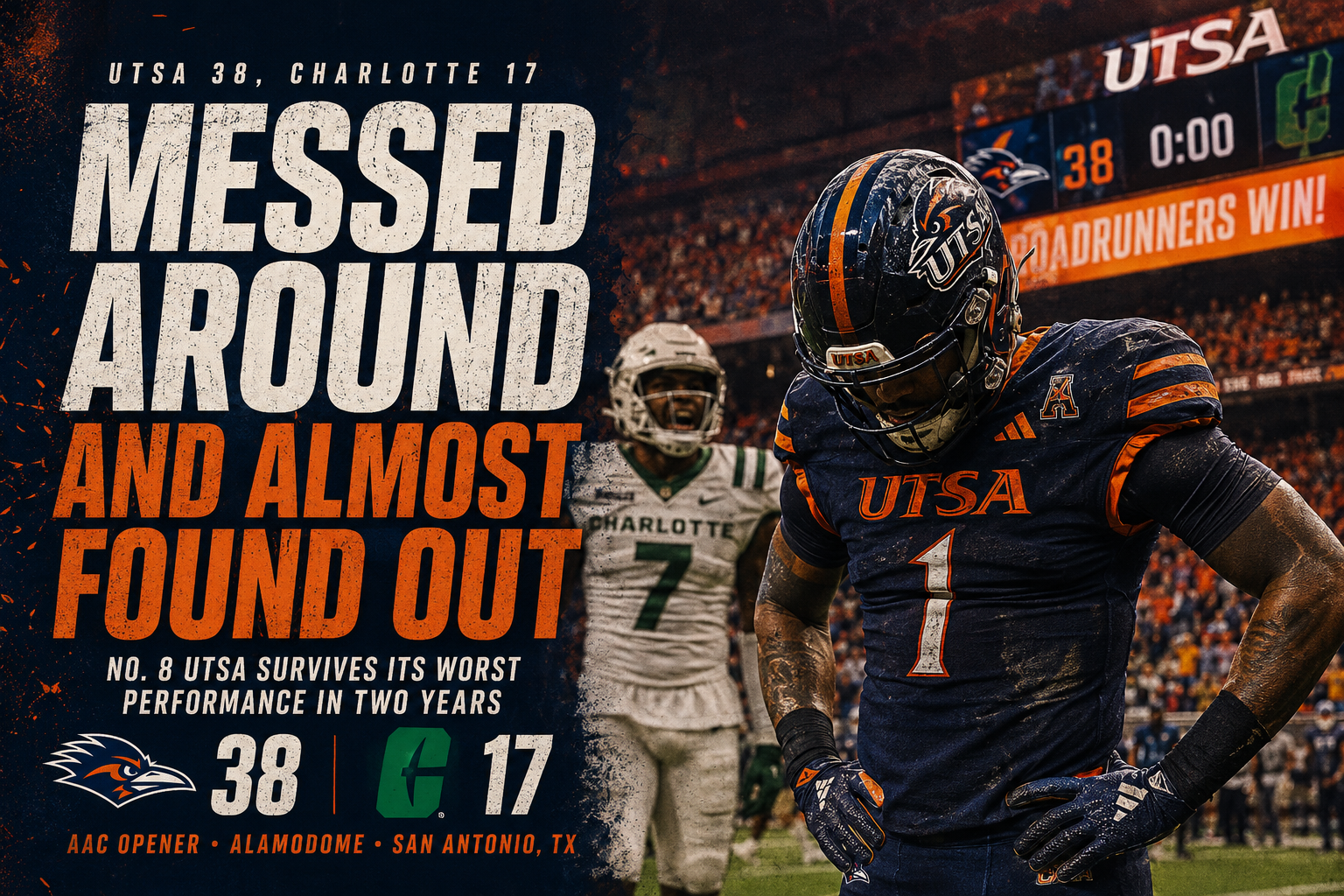
No. 8 UTSA survives three turnovers and its sloppiest performance in two years, defeating Charlotte 38–17 behind Wayshawn Parker and a resilient defense.
The scoreboard says No. 8 UTSA defeated Charlotte 38–17.
The scoreboard also leaves out nearly everything that mattered.
It does not show the three turnovers.
It does not show a missed opportunity to take control early.
It does not show Charlotte tying the game in the first quarter, ending UTSA’s season-long touchdown shutout and forcing the Alamodome to sit with a feeling it had nearly forgotten.
Doubt.
The Roadrunners won their American Conference opener by three touchdowns. They accumulated 420 yards of offense, scored on every red-zone trip and held Charlotte to 16 rushing yards.
Those are the numbers.
The truth is that UTSA spent most of Saturday afternoon fighting itself.
This was not the defending national champions at their best. It was not particularly close.
It was the sloppiest, most careless and most vulnerable performance of the Clay “Stonewall” Merritt era in nearly two years.
UTSA messed around.
Charlotte nearly helped them find out.
The Shadow of 87 Followed Charlotte to San Antonio
Some losses disappear when the season ends.
An 87–0 loss does not.
That kind of score follows a program into the offseason. It waits in the weight room. It sits inside every film session. It becomes part of every practice, every motivational speech and every conversation about whether a team has enough pride to stand up again.
Last season, UTSA did not merely beat Charlotte.
The Roadrunners erased them.
Charlotte returned to San Antonio carrying that humiliation, but it did not play like a team afraid of history repeating itself. The 49ers played like a team with nothing left to lose.
That made them dangerous.
Everyone inside the Alamodome expected another execution. UTSA had just dismantled an undefeated Colorado State team 48–3 and entered conference play ranked eighth in the country.
Charlotte entered as a memory.
The 49ers spent the first quarter proving memories can fight back.
The Roadrunners Started Reading Their Own Headlines
The warning signs existed before the opening kickoff.
UTSA was undefeated.
The Roadrunners were defending national champions.
They were ranked inside the Top 10, carrying legitimate College Football Playoff expectations and watching Wayshawn Parker’s name climb into national award conversations.
There were even rumors about UTSA’s future beyond the American Conference.
Everybody seemed interested in where the Roadrunners might be going.
Charlotte was interested in where they were.
The 49ers arrived in the Alamodome focused on the opponent directly in front of them. UTSA looked like a team thinking about everything else.
The Roadrunners were not physically overwhelmed.
They were mentally loose.
Routes were missed. Possessions were wasted. The football hit the turf. The defending champions gave an opponent they should have buried repeated opportunities to believe.
That is how mismatches become football games.
Isaiah Butler-Tanner’s Mistake Sets the Tone
UTSA’s opening offensive possession looked familiar at first.
Wayshawn Parker ran with power. Owen McCown moved the chains. Mai Anderson continued becoming one of the offense’s most reliable weapons.
Then Isaiah Butler-Tanner caught the football and lost it.
The promising drive ended with Charlotte recovering the first turnover of the game.
It was the kind of mistake UTSA had avoided throughout its dominant start to the season. It was also the kind that can infect an entire afternoon.
Charlotte gained momentum and began moving the football.
To Butler-Tanner’s credit, he did not allow the mistake to define him.
After Bray Hubbard intercepted Zach Wilcke and gave the offense another opportunity, McCown drove UTSA back into scoring range. This time, Butler-Tanner finished the possession.
Touchdown.
Redemption.
Stonewall Merritt has built his program around the belief that mistakes do not excuse the next mistake. Butler-Tanner fumbled, returned to the field and answered with a touchdown.
That response was championship football.
The problem was UTSA still had too many mistakes left to make.
Charlotte Lands the Punch Nobody Expected
For four games, the Southwest Sack Exchange had refused to surrender a touchdown.
Charlotte ended that streak before the opening quarter expired.
After UTSA took a 7–0 lead, the 49ers attacked the defense differently than previous opponents had. They spread the field, created space underneath and forced Roadrunner defenders to chase receivers across the formation.
A long completion to freshman receiver Sidney Gage flipped the field.
Soon afterward, Wilcke found running back Rod Gainey Jr. in open space. Gainey slipped through the defense and crossed the goal line.
Touchdown, Charlotte.
Seven to seven.
Last season, Charlotte scored zero points in four quarters.
This time, the 49ers needed less than one.
The Alamodome did not panic, but it became restless. UTSA had spent nearly two seasons making home games feel inevitable.
This one suddenly felt uncertain.
UTSA Takes the Lead Without Taking Control
The Roadrunners responded in the second quarter, but they never fully seized the afternoon.
UTSA moved the football, only for a promising drive to end with a missed long field-goal attempt. Charlotte continued finding opportunities through the passing game. The Roadrunners eventually settled themselves enough to score 10 unanswered points and carry a 17–7 lead into halftime.
The score created separation.
The performance did not create confidence.
UTSA had more talent.
UTSA had more speed.
UTSA controlled the line of scrimmage.
Yet Charlotte remained alive because the Roadrunners refused to stop inviting them back into the game.
A 10-point halftime lead normally feels secure inside the Alamodome.
This one felt borrowed.
The Defense Became the Adult in the Room
When the offense became careless, UTSA’s defense prevented the afternoon from becoming a disaster.
Charlotte quarterback Zach Wilcke completed 28 of 40 passes for 268 yards and two touchdowns. The 49ers found more success through the air than any opponent had managed against UTSA this season.
But the Southwest Sack Exchange kept producing answers.
Wilcke was intercepted twice.
He was sacked four times.
Charlotte was held to just 16 rushing yards.
That final number tells the real story of the defense. The 49ers could throw underneath and occasionally create an explosive play, but they could not establish any kind of balance.
UTSA forced Charlotte to become one-dimensional and then waited for Wilcke to make mistakes.
Bray Hubbard delivered the first interception after pressure flushed Wilcke from the pocket. Hubbard stepped in front of the pass and stopped a Charlotte drive that had begun after Butler-Tanner’s fumble.
Owen Pewee added another interception while finishing with 11 tackles, including five solo stops.
Brandon Tucker was everywhere.
The linebacker finished with 16 tackles, eight of them solo, and added a tackle for loss. Whenever Charlotte found space, Tucker appeared to close it.
Vic Shaw helped destroy the running game and combined with Akil Washington for an early sack. The front continued hunting even when Charlotte’s quick passing attack limited its opportunities.
The Roadrunner offense created the fire.
The defense kept extinguishing it.
Wayshawn Parker Restores Order
When UTSA needed stability, Wayshawn Parker became the answer.
Parker carried the football 18 times for 154 yards and two touchdowns, averaging 8.6 yards per attempt.
UTSA finished with 182 rushing yards as a team.
Parker accounted for nearly all of them.
Every time Charlotte gained momentum, Parker brought the Roadrunners back to something simple and reliable. Give Number One the football. Let him find the crease. Allow him to punish defenders who had already spent the afternoon chasing McCown’s receivers across the field.
Parker did not need perfect blocking.
He needed a sliver of daylight.
When he found it, Charlotte rarely had an answer.
His runs were not merely productive. They were calming. They slowed the game down and reminded UTSA that it did not need to chase explosive plays or manufacture anything complicated.
The Roadrunners already had the most reliable player on the field standing behind McCown.
When the afternoon filled with static, Parker became the clearest signal in the building.
Owen McCown Produces Through the Turbulence
Owen McCown’s performance was not flawless.
It was still productive.
The senior quarterback completed 18 of 27 passes for 238 yards, three touchdowns and one interception. He finished with a 173.6 passer rating and repeatedly found answers inside the red zone.
McCown connected with Butler-Tanner for a touchdown after the tight end’s early fumble.
He found Devin McCuin for another score.
He continued spreading the football around even as UTSA’s offense struggled to establish a consistent rhythm.
But McCown was also part of the problem.
His interception added to UTSA’s turnover total and gave Charlotte another possession it had not earned through defensive dominance. His overall numbers were strong, but this was not the clean, patient command he had displayed against Colorado State.
There is a difference between producing and controlling a game.
McCown produced.
UTSA rarely felt in control.
Devin McCuin and Isaiah Butler-Tanner Supply the Touchdowns
The Roadrunners did not have a receiver dominate the stat sheet, but they continued receiving contributions across the formation.
Isaiah Butler-Tanner caught five passes for 65 yards and one touchdown. His early fumble could have sent him into the background.
Instead, he returned to become one of McCown’s most productive targets.
Devin McCuin added five catches for 43 yards and a touchdown. The senior continued providing the reliability UTSA needed as the offense worked through an uneven day.
Neither player produced a massive yardage total.
Both produced points.
On an afternoon when UTSA repeatedly created its own problems, finishing drives became essential. Butler-Tanner and McCuin made sure the Roadrunners did not waste every opportunity.
Three Turnovers Turned a Mismatch Into a Fight
The box score makes the game look comfortable.
UTSA recorded 26 first downs.
Charlotte recorded 12.
UTSA gained 420 total yards.
Charlotte gained 284.
UTSA rushed for 182 yards.
Charlotte rushed for 16.
The Roadrunners converted all five red-zone opportunities into points. The 49ers scored on two of their three trips.
By nearly every conventional measure, UTSA dominated.
Then there is the turnover column.
UTSA gave the football away three times.
Charlotte gave it away twice.
For the first time during this championship run, an opponent won the turnover battle and forced the Roadrunners to live with the consequences.
Charlotte did not need to dominate the line of scrimmage because UTSA kept handing away possessions.
The 49ers did not need to control the game because the Roadrunners kept refusing to put it away.
Charlotte did not outplay UTSA.
UTSA kept inviting Charlotte back into the building.
Against the 49ers, the Roadrunners survived.
Against another Top 10 team, three giveaways could end a season.
Talent Finally Creates Separation
UTSA entered the fourth quarter leading 24–7.
The Roadrunners had begun creating distance, but Charlotte refused to disappear.
The 49ers scored 10 points in the final quarter, showing the same resilience that had kept them alive throughout the afternoon.
UTSA answered with 14.
That final response turned an uncomfortable game into a 38–17 result that will eventually look routine in the record book.
It was anything but routine.
The Roadrunners eventually won because they were deeper, faster and more talented. Parker continued breaking through the defense. McCown continued finishing possessions. The defense refused to allow Charlotte to build a running game.
Talent won the game.
Discipline nearly lost it.
Charlotte Earned More Than a Moral Victory
Charlotte deserves credit.
The 49ers did not walk into San Antonio expecting another public execution.
Wilcke stood inside the pocket, completed 70 percent of his passes and continued challenging a defense that had suffocated every previous opponent.
Rod Gainey Jr. rushed for 39 yards, caught five passes for 42 yards and scored a touchdown.
Javen Nicholas caught seven passes for 73 yards and repeatedly provided Wilcke with an option underneath.
Charlotte forced three turnovers and became the first team this season to score a touchdown against UTSA’s defense.
The 49ers did not erase 87–0.
Nothing can.
They did prove they were no longer willing to be defined by it.
Charlotte walked into the standard and made the standard uncomfortable.
That matters.
The Worst Performance of the Stonewall Merritt Standard
Calling this UTSA’s worst performance in two years sounds strange when the Roadrunners won by 21 points.
That is exactly what makes it true.
Stonewall Merritt has raised expectations so high that 38 points, 420 yards and a conference victory can still feel unacceptable.
The problem was not the final margin.
The problem was how UTSA reached it.
The Roadrunners were careless with the football.
They lacked their normal focus.
They failed to bury an inferior opponent when several opportunities appeared.
They played like a team that expected the championship banner to win the game for them.
The banner does not make tackles.
The ranking does not protect the football.
The crown does not excuse complacency.
That is the blessing and burden of the kingdom Stonewall built.
A 21-point conference win can still feel like somebody tracked mud across the throne room.
Winning Ugly Is Still Winning
Every championship team survives one game it would rather forget.
A game in which the timing is wrong, the focus drifts and the favorite spends three hours wandering too close to consequences.
The best teams find a way to survive those afternoons.
UTSA survived.
The Roadrunners did not panic when Charlotte tied the game.
They did not collapse after the turnovers.
They continued leaning on Parker, trusted the defense and found enough touchdowns to create separation.
There is value in that.
Great teams are not great because they play perfectly every week.
They are great because their worst football does not always become a loss.
The scoreboard says UTSA won by 21.
The film says the Roadrunners escaped with a lesson.
The Bye Week Arrives at the Right Time
UTSA now receives a week away from competition before traveling to Houston to face Rice.
The timing could not be better.
The Roadrunners need time to heal physically.
More importantly, they need time to reset mentally.
They need to secure the football.
They need to restore the focus that carried them through Baylor, Texas State, Texas and Colorado State.
They need to stop thinking about playoff rankings, Heisman conversations and conference realignment rumors long enough to remember how quickly a season can change.
The bye week is not a celebration.
It is a correction period.
Stonewall Merritt now has two weeks to make sure this performance becomes a warning instead of a pattern.
Before UTSA Leaves the American, It Must Handle the American
The rumors surrounding UTSA’s future will not disappear during the bye week.
The Roadrunners have become bigger than the program Charlotte faced a season ago. They are national champions, a Top 10 team and one of the most attractive programs outside the traditional power structure.
Everyone wants to discuss what comes next.
The American Conference still exists in the present.
Charlotte proved that conference opponents will not line up simply to admire UTSA’s crown. They will attack it. They will study the weaknesses. They will carry every blowout, every celebration and every dismissive prediction into the rematch.
Before the Roadrunners worry about leaving the American behind, they must finish conquering it.
Saturday showed that task will not complete itself.
Next Stop: Houston
Rice waits on the other side of the bye.
The Owls are an institution more famous for academics than athletics, but UTSA has not earned the right to laugh at that joke yet.
Rice will study this film.
The Owls will see Butler-Tanner’s fumble.
They will see McCown’s interception.
They will see Charlotte creating space through the passing game and turning Roadrunner mistakes into scoring opportunities.
They will also see Parker rushing for 154 yards.
They will see a defense that allowed only 16 yards on the ground.
They will see a team that played its worst game in two years and still won by three touchdowns.
That is the complicated truth about No. 8 UTSA.
The Roadrunners looked vulnerable.
They also remained undefeated.
Charlotte reminded everyone that championships can be lost one careless Saturday at a time.
Fortunately for UTSA, the lesson arrived without the full price.
The Roadrunners messed around.
They almost found out.
Now we find out whether they were paying attention.
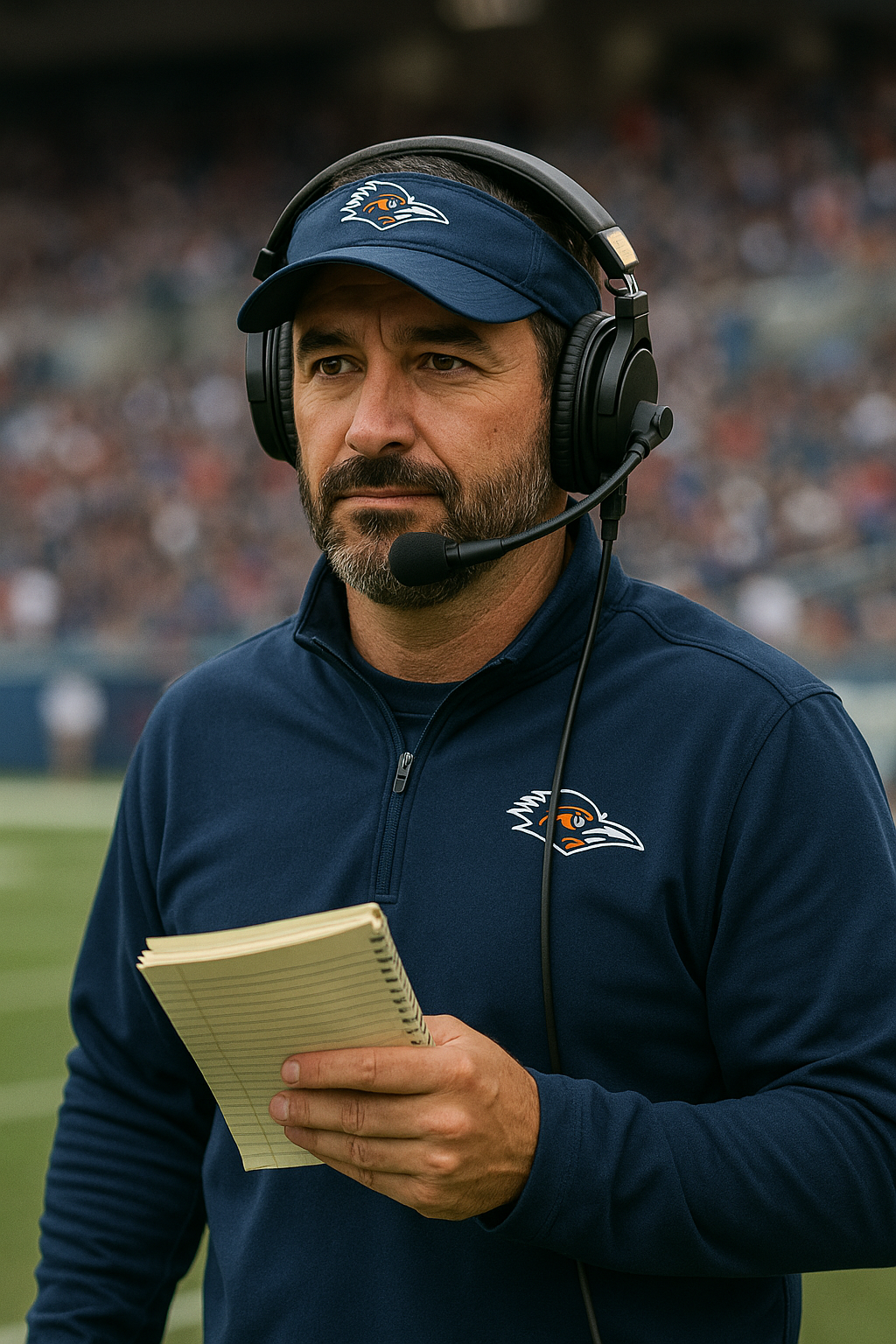
Frankie Calderón, better known across Texas airwaves as “The Horn,” is a no-nonsense football lifer with a sharp tongue and a soft spot for the underdog. Raised just outside of Pueblo, Colorado, Frankie cut his teeth covering JUCO ball and D2 programs before turning heads with his bold coverage of the Western Colorado Mustangs — and one fiery young coach named Clay Merritt.
When Merritt made the leap to UTSA, Frankie followed — not as a coach, but as the unofficial voice of the program, launching Runner Nation Radio and embedding himself in the culture of the team.
Fans love him. Opposing coaches fear him. And Stonewall? He respects the hell out of him.
THE MORNING AFTER — WEEK 6: Texas Stunned, Georgia Takes the Throne & Oregon Implodes