Remember the Alamodome: UTSA Turns Baylor’s “Restore Order” Mission Into a 73-0 Warning
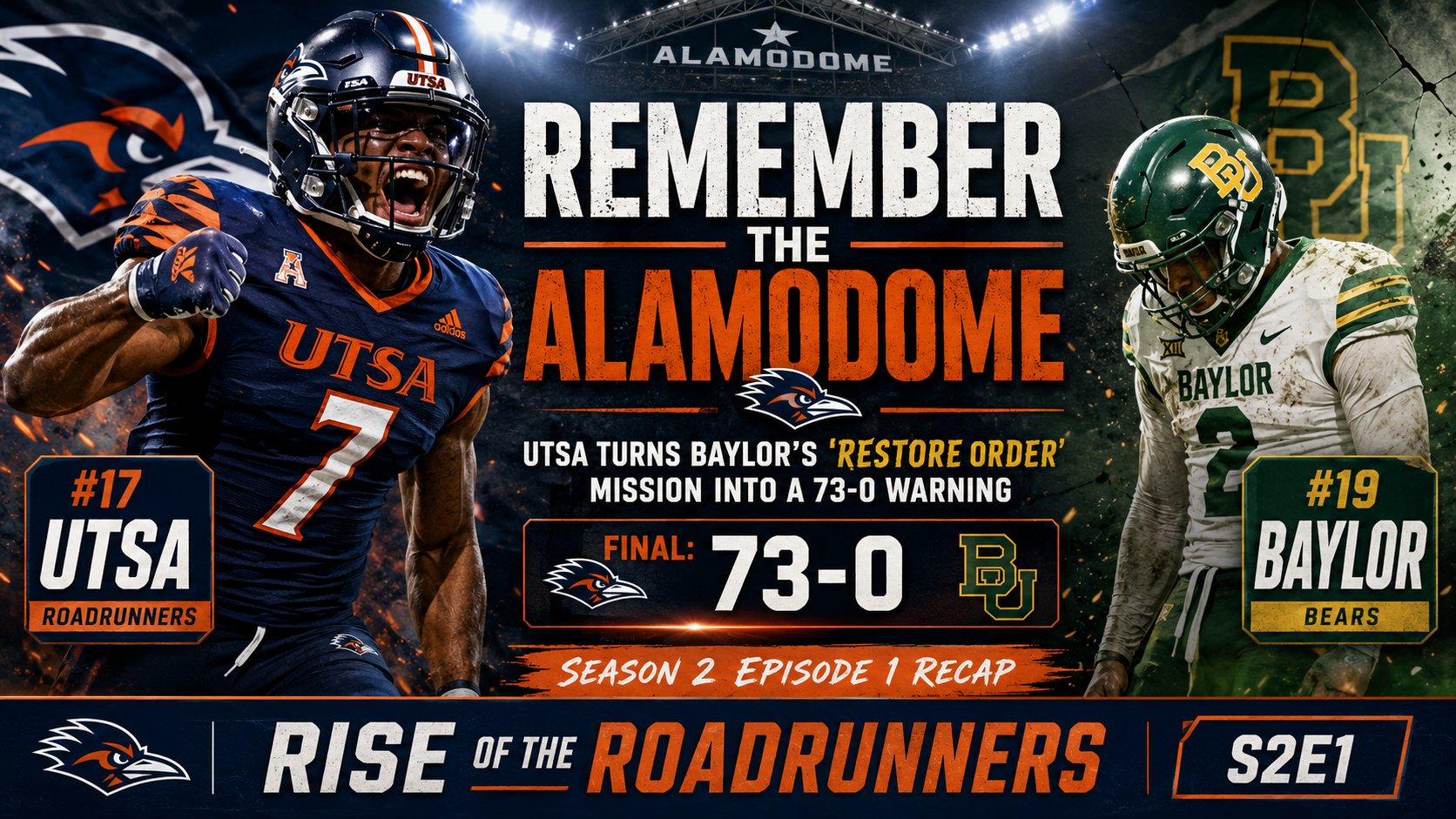
Remember the Alamodome: UTSA Turns Baylor’s “Restore Order” Mission Into a 73-0 Warning
By Frankie “The Horn” Calderón — 94.3 The Bird
Baylor came to San Antonio to restore order.
That was the story. That was the mission. That was the reason the Big 12 logo mattered when the No. 19 Bears walked into the Alamodome to face No. 17 UTSA in the Season 2 opener of Rise of the Roadrunners.
They were not just another opponent. They were the first test of the title defense. They were the first ranked team asked to stand across from Clay “Stonewall” Merritt’s program after the Roadrunners turned Season 1 into a 17-0 national championship campaign. They were the first team given a chance to tell the college football world that last year was magical, special, and maybe impossible to repeat.
Then the ball was kicked.
Then Wayshawn Parker touched it.
Then the Southwest Sack Exchange walked back into the building.
Then Baylor learned something the rest of the country may want to write down before sending another ranked opponent into San Antonio.
The Roadrunners are not defending a miracle.
They are defending a kingdom.
And after a 73-0 demolition of Baylor inside the Alamodome, that kingdom looks very much alive.
Final Score: No. 17 UTSA 73, No. 19 Baylor 0
This was not a close game that got away late. This was not a fourth-quarter avalanche that made the final score look worse than the actual contest. This was not one of those openers where a contender starts slow, finds rhythm, and eventually pulls away.
This was immediate.
UTSA led 28-0 after the first quarter. The Roadrunners stretched it to 49-0 by halftime. By the time the third quarter ended, it was 66-0. Baylor spent the fourth quarter trying to avoid the goose egg, and even that proved to be too much.
The final numbers look less like a box score and more like a warning label.
| Category | UTSA | Baylor |
|---|---|---|
| Final Score | 73 | 0 |
| First Downs | 23 | 4 |
| Total Offense | 480 | 51 |
| Yards Per Play | 12.0 | 1.2 |
| Rushing Yards | 297 | 24 |
| Passing Yards | 183 | 27 |
| 3rd Down | 5/6 | 1/12 |
| Turnovers | +2 | -2 |
Baylor came in with size. Baylor came in with speed. Baylor came in with the Big 12 patch and the confidence of a ranked team that believed it could remind UTSA how the sport was supposed to work.
Instead, the Bears left with four first downs.
That is the recap.
That is the headline.
That is the sound of the old order getting folded up and sent back to Waco.
Wayshawn Parker Did Not Wait for Permission
The biggest question entering Season 2 was never whether UTSA had talent. It was whether the Roadrunners still had a heartbeat after Robert Henry Jr. walked out of the story.
Henry was not just a running back in Season 1. He was the pulse. He was the tone-setter. He was the back who made defenses tired, made drives feel inevitable, and made UTSA’s rise feel physical. You do not simply replace that kind of player with a new number and a clean depth chart.
Wayshawn Parker understood that.
Then he answered anyway.
On the very first offensive drive of the season, Parker introduced himself with the kind of burst that changes a stadium. His first carry showed the vision. His third carry showed the violence. On third-and-short, he cut up the middle, hit open space, made Baylor defenders look like they were taking bad angles in slow motion, and found the end zone for the first touchdown of Season 2.
Beep beep.
The Roadrunners were back.
And Parker was not finished.
By the time the game had settled into its first rhythm, Parker had already turned the night into his arrival party. He finished with 9 carries for 100 yards and 3 touchdowns, averaging 11.1 yards per carry. He did not need 25 touches to prove the job was his. He needed one quarter.
That matters.
Because the first game after a championship can get heavy. The banner is beautiful, but it can also become a weight. Every carry becomes a comparison. Every new starter gets measured against the ghost of the player who came before him. Every fan wants to know if the next chapter can still sound like the last one.
Parker made sure the answer came early.
Robert Henry Jr. gave UTSA its heartbeat.
Wayshawn Parker did not copy the rhythm.
He changed the tempo.
The First Quarter Was a Public Service Announcement
Baylor’s first quarter was supposed to be the feeling-out period. The Bears wanted to survive the early emotion, settle Walker White into the game, and make UTSA prove it could operate like a champion with new pieces in new roles.
Instead, Baylor’s first quarter became a public service announcement for every team left on the schedule.
Do not get behind the chains against this defense.
Do not hold the ball too long.
Do not assume the Roadrunners lost their bite just because the calendar changed.
After Parker’s opening touchdown made it 7-0, Baylor’s offense got its first real chance to answer. That chance lasted until third down. Chidera Otu came screaming through, Walker White lost the football, and Akil Washington turned the loose ball into six points the other way.
Just like that, 14-0.
Then Baylor tried again.
Same problem. Different disaster.
Vic Shaw got involved. The pressure arrived. The ball came out again. Otu recovered it, and suddenly the UTSA offense only needed to go 10 yards. Owen McCown kept it himself on a read option and walked the Roadrunners into a 21-0 lead.
That was the moment the game changed from a ranked matchup into a statement.
The offense had already shown it could drive the field. The defense had already shown it could score. The Bears had not even finished blinking, and they were down three touchdowns in a stadium that was only getting louder.
By the end of the first quarter, UTSA led 28-0.
Baylor was not losing.
Baylor was being introduced to the standard.
The Southwest Sack Exchange Is Still Open for Business
The Roadrunners’ defense was the soul of Season 1. It gave the dynasty its teeth. It made big games feel small. It took teams with NFL bodies, Power Five confidence, and national expectations, and turned them into third-and-long machines.
Against Baylor, that group looked even meaner.
Chidera Otu was the face of the wreckage. He finished with 6 tackles, 6 tackles for loss, 3 sacks, 2 forced fumbles, and 1 fumble recovery. That is not a stat line. That is a hostile takeover.
Vic Shaw was right there with him. Four tackles, four tackles for loss, and 1.5 sacks. Shaw was not just productive; he was disruptive in the way that changes play-calling. Baylor could not run away from the pressure because the pressure was everywhere.
Akil Washington added 4 tackles, half a sack, and the scoop-and-score touchdown that turned the first quarter into a rout.
This was the kind of defensive performance that makes coordinators throw away the first half of the call sheet. Baylor wanted to run through Tawn King. They could not. Baylor wanted Walker White to settle in. He could not. Baylor wanted to at least find enough rhythm to steal a few first downs and calm the game. They finished with four first downs total.
Four.
For the whole game.
That is the difference between a good defense and a defense that makes an opponent question the sport.
The Southwest Sack Exchange did not reopen quietly.
It kicked the door off the hinges.
Owen McCown Looked Like a Champion, Not a Passenger
The funniest part of a 73-point performance is that Owen McCown did not have to chase numbers to control the game.
He did not throw for 400 yards. He did not need to. He did not spend the fourth quarter hunting touchdowns. He did not need to. He did not have to force anything, because the Roadrunners never needed saving.
That is what made his performance so clean.
McCown finished 11-for-14 passing for 154 yards and 3 touchdowns. He added 59 yards and a touchdown on the ground. His final passer rating was 246.6, and he was named Player of the Game.
That is command.
Not chaos. Not stat-padding. Not a quarterback trying to prove he is the story.
Command.
McCown looked like a veteran who understood exactly what this opener required. When Baylor overcommitted to Parker, he kept the ball. When UTSA needed a throw, he found it. When the red zone tightened, he stayed patient. When the game turned into a blowout, he let the offense keep its rhythm without turning reckless.
The captain did not have to be spectacular because the machine around him was already rolling.
But make no mistake.
He was spectacular in the ways that win championships.
Mekhi Anderson Is Becoming More Than a Return Specialist
One of the most important developments of this opener came from a familiar name in a slightly different role.
Mekhi Anderson was already known as a return weapon. Last season, every punt and kick gave him a chance to tilt the field and change the energy of a game. Against Baylor, he still did that. Six punt returns for 134 yards is not normal. A 22.8-yard average on punt returns is not a hidden stat. That is field position being stolen in broad daylight.
But the more interesting part was what Anderson did as a receiver.
Six catches. Seventy-eight yards. One touchdown.
That is where the story grows.
Anderson looked comfortable working over the middle. He gave McCown a reliable target. He turned routine completions into movement. He looked less like a gadget player and more like a piece of the offensive identity.
For a team replacing legends, that matters.
Because the defending champion does not only need stars to stay stars. It needs role players to become weapons. It needs familiar names to expand. It needs the roster to evolve before opponents catch up to last year’s tape.
Anderson gave UTSA exactly that.
He flipped field position.
Then he helped finish drives.
If that continues, the Roadrunners’ offense just added another problem for the country to solve.
Frankie Arthur Proved the Depth Chart Has Teeth
When a game reaches 49-0 at halftime, the second half can become empty football. The starters sit. The crowd relaxes. The broadcast starts looking ahead. The rhythm fades.
That did not happen here.
The backups entered, and UTSA still looked dangerous.
Frankie Arthur made sure of it.
Arthur finished with 6 carries for 123 yards and a touchdown, averaging 20.5 yards per carry. He also added 2 punt returns for 28 yards. His 80-yard touchdown run in the third quarter did not feel like a random garbage-time explosion. It felt like the next wave of the program showing its face.
That is what should scare people.
Championship teams are hard to beat when the starters are better than yours. Dynasties are hard to beat when the backups look like they are auditioning for their own era.
Arthur ran through Baylor like the score was still 0-0. Nathan Wallace caught his first career touchdown like the future was already being built in real time. The offensive line kept moving bodies. The defense kept closing doors. Even late, with the game long decided, the Roadrunners were still sharper, faster, and more physical.
That is culture.
That is development.
That is Stonewall Merritt’s program refusing to treat the second half like a formality.
Baylor’s Problem Was Bigger Than the Score
It is easy to look at 73-0 and stop there. The score is loud enough on its own. But the deeper issue for Baylor is what the numbers revealed.
The Bears did not just get outscored. They got erased.
They had 51 total yards.
They averaged 1.2 yards per play.
They went 1-for-12 on third down.
They turned the ball over twice.
They did not score.
They barely threatened.
They crossed midfield so late that it felt like an achievement instead of a drive.
That is the part that changes how this game should be remembered. Baylor was not some unranked tune-up opponent brought in to take a check and absorb a beating. Baylor was ranked No. 19. Baylor was the Power Four measuring stick. Baylor was supposed to bring credibility to the question.
Was UTSA real?
By the end, Baylor had accidentally answered it for everyone.
Yes.
Very.
Stonewall Merritt Did Not Need 80
There was a final moment that said a lot about the man running this program.
With the Roadrunners ahead 73-0, Frankie Arthur broke off more yardage late. UTSA had the ball. The clock was running. The offense was near scoring range again. Clay “Stonewall” Merritt could have called a timeout. He could have chased 80. He could have let the scoreboard become even more ridiculous.
He did not.
Merritt let the clock go.
That was not mercy in the soft sense. That was control. That was a coach who knew the message had already been delivered. That was a program secure enough not to beg for one more punch after the fight was already over.
Seventy-three was enough.
The shutout was enough.
The first downs were enough.
The film was enough.
The country saw it.
Baylor felt it.
Texas State better study it.
The Road to the I-35 Showdown Starts With a Warning
Next up is the I-35 showdown against Texas State, and the tone of that game changed the moment UTSA finished this one.
Before Baylor, the question was whether the Roadrunners could restart the engine.
Now the question is whether anyone can slow it down.
Season 2 opened with the defending national champions ranked No. 17, hosting No. 19 Baylor in a game that was supposed to test the crown. Instead, the Roadrunners turned the opener into a reminder that the Alamodome is not just a stadium anymore.
It is a proving ground.
It is where doubt goes to die.
It is where Power Four confidence gets stripped down and exposed.
Baylor came to restore order.
UTSA reminded them the order had already changed.
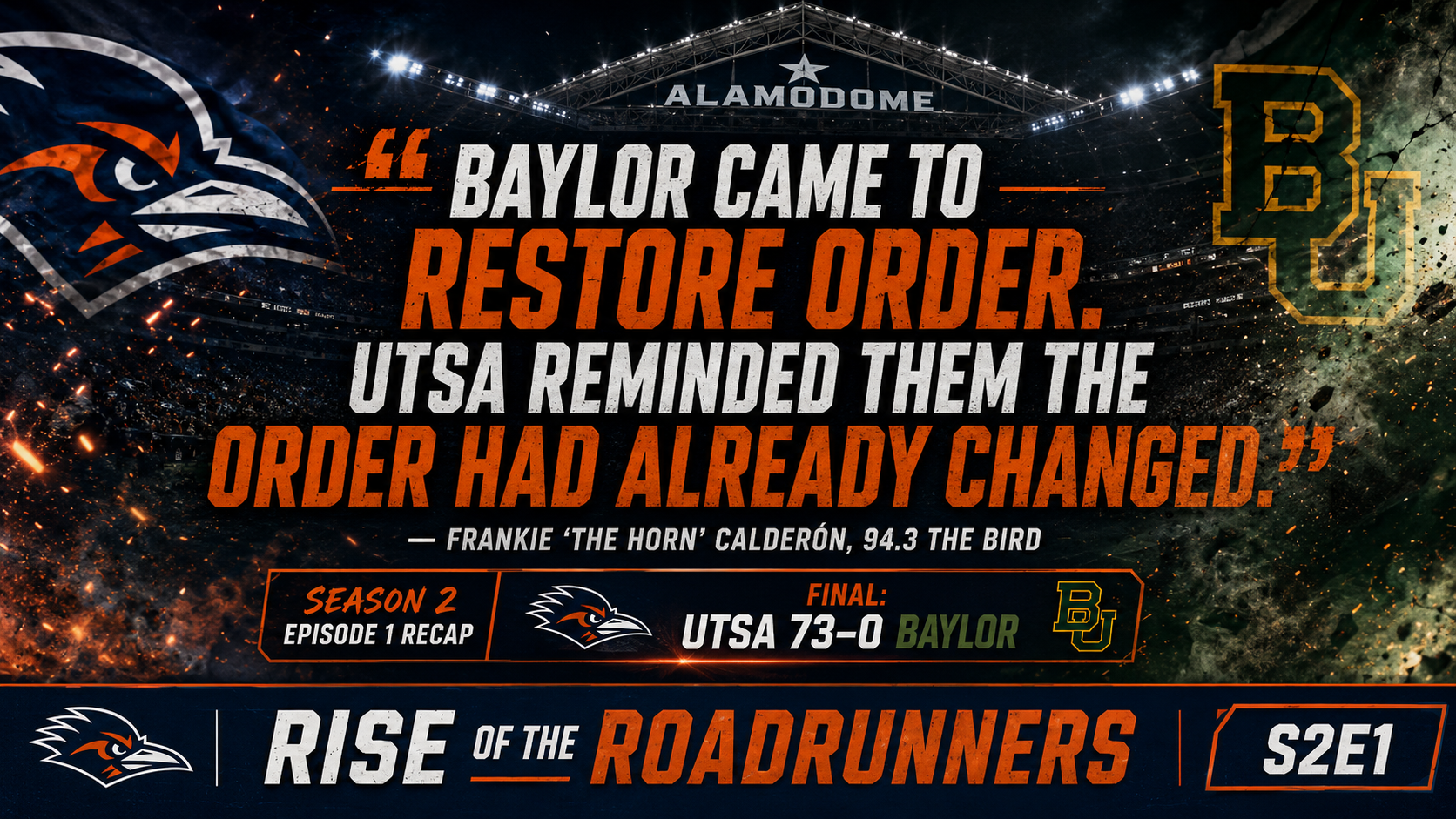
The final from San Antonio: Roadrunners 73, Bears 0.
The reign continues.
And if this was the warning shot, the rest of the country may want to start running before the beep beep gets any closer.
Game MVP: Owen McCown
Owen McCown earns Player of the Game honors after finishing with four total touchdowns, three through the air and one on the ground. He controlled the offense, protected the football, and reminded everyone that UTSA’s title defense still runs through a quarterback who understands the assignment.
Offensive Player of the Game: Wayshawn Parker
Three touchdowns in his Roadrunner debut. One hundred yards on nine carries. The first major answer to the Robert Henry Jr. question. Parker was explosive, decisive, and dangerous from the first drive of the season.
Defensive Player of the Game: Chidera Otu
Six tackles. Six tackles for loss. Three sacks. Two forced fumbles. One fumble recovery. Baylor will be seeing No. 93 in the film room all week, and maybe in their nightmares a little longer than that.
Next Week: Texas State Comes to San Antonio With a Score to Settle
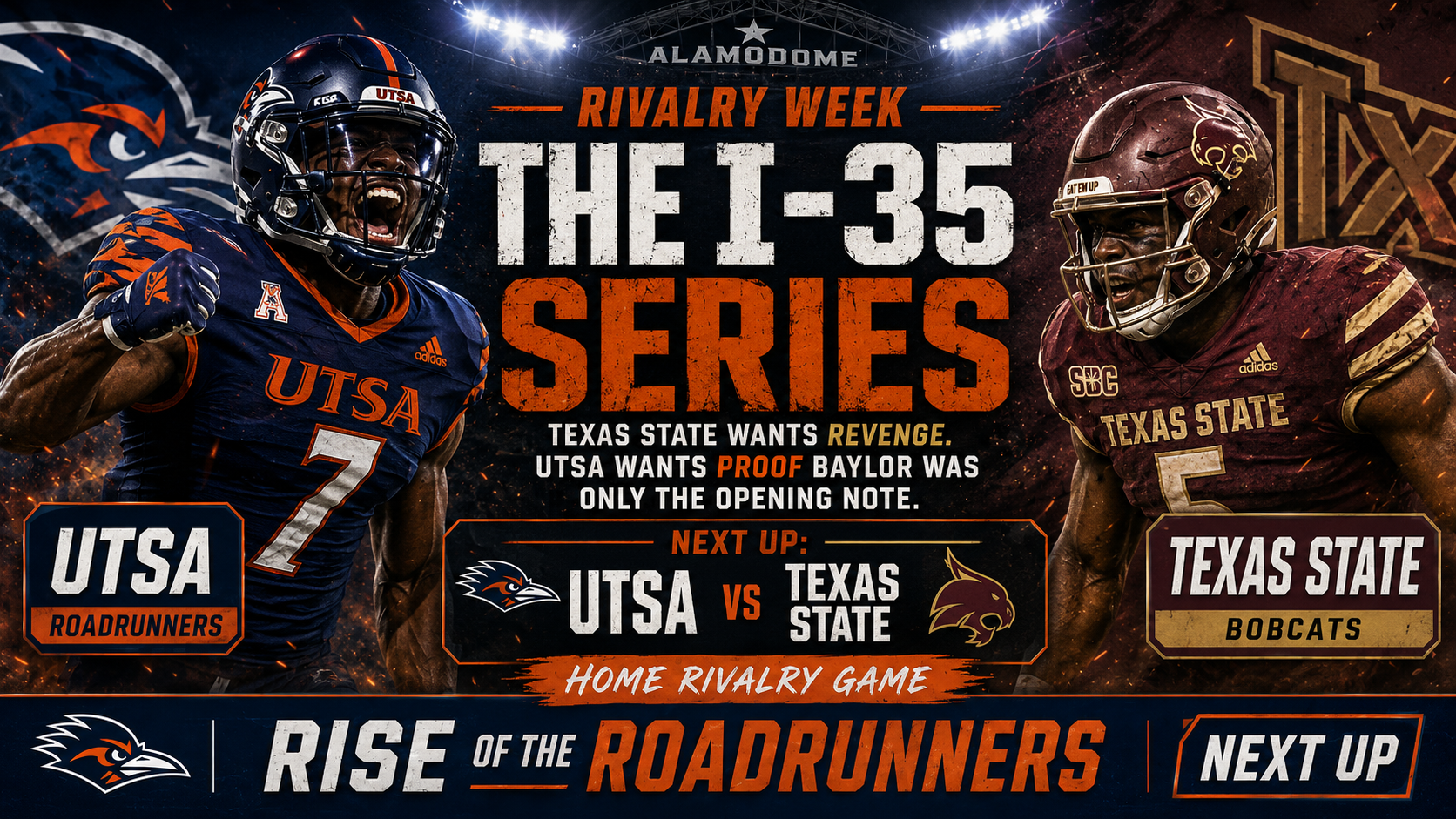
The Baylor warning shot is finished.
Now the rivalry week fuse gets lit.
Next week, the Roadrunners stay home inside the Alamodome for the I-35-7 series against Texas State, and do not think for one second the Bobcats have forgotten what happened the last time these two programs shared a field.
Last season in San Marcos, UTSA did not just beat Texas State.
They shut them out.
They walked into the Bobcats’ house, took the air out of the rivalry, and left Texas State with the kind of humiliation that sits in a locker room for an entire offseason. That is not just a loss. That is a scar. That is the kind of result coaches put on screens in January. That is the kind of result players hear about in the weight room, on campus, and from every person who wants to know when the Bobcats are going to punch back.
Now Texas State gets its chance.
The problem?
The rematch is not in San Marcos.
It is in San Antonio.
It is inside the Alamodome, where the Roadrunners have turned doubt into dust and where Baylor just found out how quickly a ranked opponent can become a cautionary tale. The Bobcats are not walking into a normal rivalry game. They are walking into the home of the defending national champions one week after UTSA posted 73 points, forced a shutout, and reminded the sport that Season 2 is not a rebuild.
It is a reign.
That makes this matchup dangerous in both directions.
For Texas State, this is a chance to get back on track, reclaim some pride, and prove that last year’s shutout was not the true gap between the programs. Rivalry games do not care about rankings once the ball is kicked. They do not care about last week’s box score. They care about emotion, physicality, and whether the team with revenge on its mind can turn anger into execution.
For UTSA, this is a different kind of test.
Baylor tested the crown.
Texas State tests the edge.
Can Stonewall Merritt’s team follow a 73-0 masterpiece with the same focus? Can Wayshawn Parker carry his debut into rivalry week? Can Owen McCown keep the offense clean when the opponent’s entire week is built around making the game ugly? Can the Southwest Sack Exchange treat the Bobcats like the next name on the schedule instead of getting drunk on what they just did to Baylor?
That is the challenge of a dynasty.
Winning big is one thing.
Stacking domination is something else.
Texas State is coming to San Antonio embarrassed, motivated, and desperate to change the memory of this series. UTSA is staying home with the crown, the confidence, and a fan base that just watched the Roadrunners turn a ranked Big 12 opponent into a 73-0 headline.
The I-35 series is next.
The Bobcats want revenge.
The Roadrunners want proof that the Baylor game was not the peak.
It was the opening note.
Final Word
Season 1 was the rise.
Season 2 begins as the reign.
And after Baylor walked into the Alamodome trying to restore order, UTSA sent the first message of the new campaign in all caps.
The Roadrunners are still here.
The crown is still heavy.
And Stonewall Merritt’s team still looks strong enough to carry it.
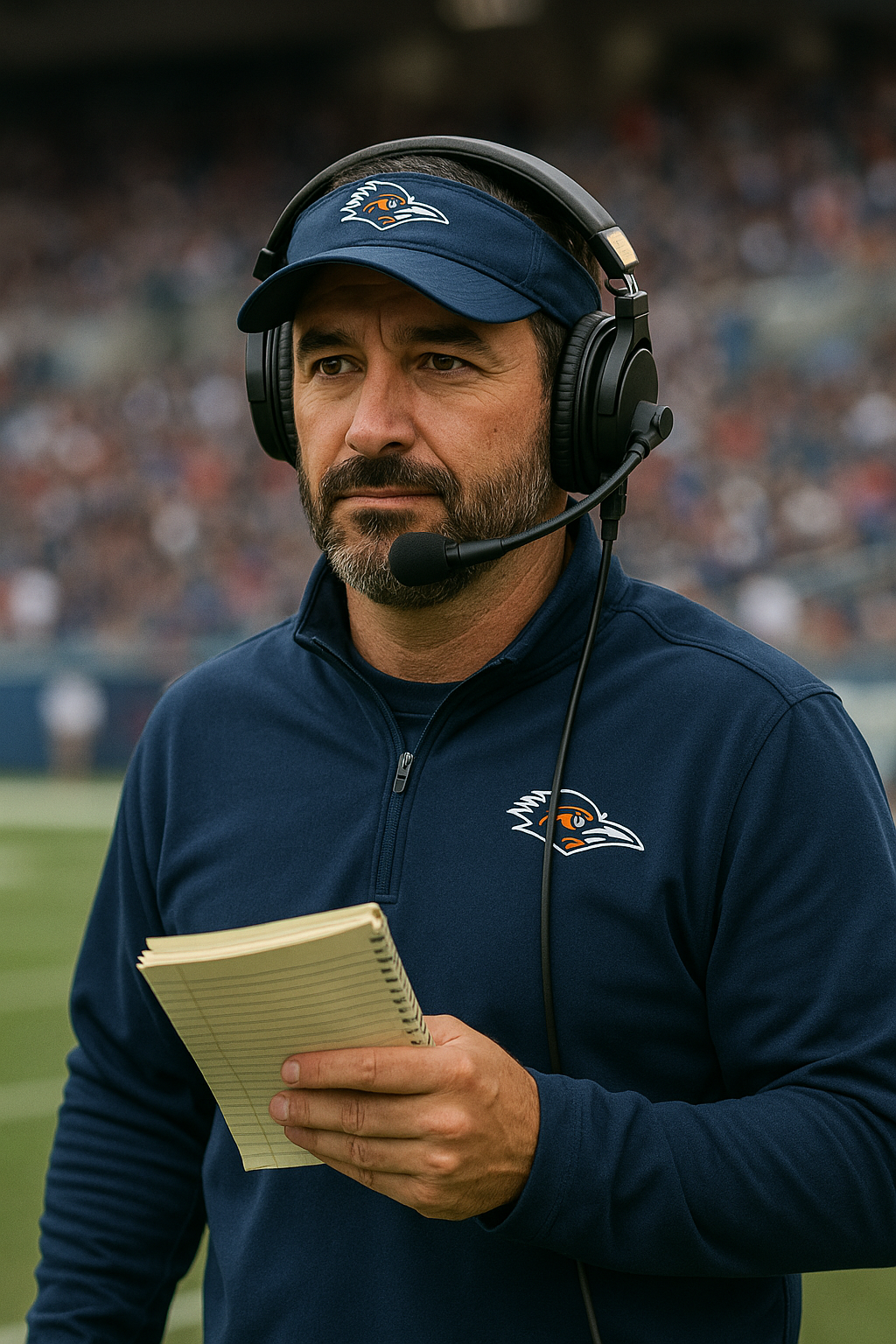
Frankie Calderón, better known across Texas airwaves as “The Horn,” is a no-nonsense football lifer with a sharp tongue and a soft spot for the underdog. Raised just outside of Pueblo, Colorado, Frankie cut his teeth covering JUCO ball and D2 programs before turning heads with his bold coverage of the Western Colorado Mustangs — and one fiery young coach named Clay Merritt.
When Merritt made the leap to UTSA, Frankie followed — not as a coach, but as the unofficial voice of the program, launching Runner Nation Radio and embedding himself in the culture of the team.
Fans love him. Opposing coaches fear him. And Stonewall? He respects the hell out of him.
The Morning After — Week 2: Stillwater Shock, Michigan Muscle, Texas’ Miracle & Border War Bad Blood