The Avs Are Buried, New York Is On Fire, and Wemby Is Looming

There are episodes where we get to celebrate. There are episodes where we get to laugh through the chaos. Then there are episodes where we have to sit down, look at the wreckage, and admit the thing we all saw with our own eyes.
Episode 276 of The Far End of the Bench is one of those episodes.
Vegas did not just beat the Colorado Avalanche. Vegas buried them.
The Knicks did not just win the Eastern Conference. They turned New York into the center of the basketball universe again.
And Victor Wembanyama? He is sitting out West like the final boss everyone can see coming, but nobody is fully ready to deal with yet.
Before we got into the sports funeral, though, we started where the week deserved to start: Memorial Day.
Memorial Day Is More Than the Start of Summer
Memorial Day always brings that unofficial start-of-summer feeling. Pools open. Grills fire up. Teachers start trying to remember what day it is. The sports calendar shifts into that weird but beautiful zone where the NHL and NBA are trying to crown champions while summer leagues and summer sports start finding their lane.
But Memorial Day is not just a long weekend.
It is not just barbecue, pool time, or a Monday off.
It is a reminder that the freedom to sit here and argue about hockey collapses, basketball chaos, and lacrosse storylines exists because other people paid a cost most of us will never fully understand.
That is the tone we wanted to hit before the episode turned into an Avalanche eulogy. We can joke. We can rant. We can fire takes into the internet and argue in comment sections. But the reason we get to do that freely is because of the men and women who did not make it home, and the families who carry that sacrifice every single day.
So before the Bench got loud, it had to get thankful.
The Avalanche Season Ends in a Funeral
Now to the pain.
There is no better word for the Colorado Avalanche ending than a funeral.
This team entered the Western Conference Final with all the regular-season credibility in the world. The Avs had the points. They had the stars. They had the expectations. They had the kind of roster that makes you believe the Cup window is still open.
Then Vegas walked in and made the whole thing look hollow.
Game 1 was the warning. Game 2 was the heartbreak. Game 3 was the collapse. Game 4 was the quiet end.
That might be the most frustrating part. The Avalanche did not go out in some seven-game war where you could say both teams emptied the tank and somebody had to lose. They got swept. They got outscored. They got outstructured. They got out-toughed. They got out-goalied. They got out-coached in stretches. And most importantly, they got out-answered.
Every time Vegas threw a punch, Colorado looked like it was searching for a response that never came.
The Avs had moments. They had flashes. They had the 3-0 lead in Game 3 that briefly made everyone think the series might flip. Then the whole thing melted down, and that was the moment where the series stopped feeling like bad luck and started feeling like an identity audit.
Vegas did not expose one bad night.
Vegas exposed the season.
Vegas Had the Structure Colorado Did Not
The difference between the Avalanche and Golden Knights was not just talent. Colorado has talent. Colorado has world-class talent. Colorado has players who should scare anybody in hockey.
But Vegas had structure.
Vegas knew how it wanted to win. Vegas knew how to make the game ugly. Vegas knew how to clog the middle, lean into physicality, force Colorado’s depth to beat them, and trust that Carter Hart could outplay the chaos on the other end.
That was the formula, and the scary part is how obvious it became.
Be more physical. Check.
Win the goaltending battle. Check.
Make the stars uncomfortable. Check.
Tell everyone outside the top names to beat you. Check.
When you get to the Western Conference Final and five of your top six do not give you enough, it stops being a fluke. That is not just “puck luck.” That is a failure of execution at the exact moment the season demanded something more.
The Avalanche looked like a team that could dominate the regular season but did not have enough answers when a playoff team with a real plan punched back.
That is why this one hurts differently.
The Bednar Conversation Is Complicated
Now comes the conversation nobody in Avalanche country wants to have cleanly because there is no clean answer.
Should Jared Bednar stay or go?
The easy angry take is to fire him. The easy loyal take is to defend him because he has a Stanley Cup and is one of the best coaches in franchise history.
The truth is somewhere much more uncomfortable.
Bednar was let down by his players. That has to be said. When your highest-paid offensive weapons disappear, that cannot all be placed on the coach. Coaches can draw it up. Coaches can adjust. Coaches can challenge the room. But they cannot physically put the puck in the net for players who are paid to do exactly that.
At the same time, this is professional sports. Players can cost coaches jobs. It happens at every level. It happens in high school. It definitely happens in the NHL.
The real question is not, “Is Bednar a good coach?”
He is.
The question is, “Is Bednar still the right voice for this version of the Avalanche?”
That is where things get harder.
If Colorado fires him just to make a move, that is dangerous. If they fire him and replace him with a true difference-maker, that might be the reset this roster needs. But if they fire him and promote from within just to call it change, then what actually changed?
That is why the conversation is not black and white.
Keeping Bednar might be defensible. Running everything back without demanding a new playoff identity is not.
The Goalie Situation Cannot Be Ignored
The one area where Bednar’s decisions deserve real heat is the goalie situation.
Colorado never felt fully settled in net. Mackenzie Blackwood was the guy. Then Scott Wedgewood became part of the playoff equation. Then by the time Colorado needed stability the most, it felt like the Avs were trying to win a Western Conference Final without a clear answer at the most important position in postseason hockey.
The old quarterback line applies here: if you have two number ones, you probably do not have one.
Blackwood was good in Game 4. He gave Colorado a chance. But the larger problem had already been created. This team never felt like it had the kind of unquestioned playoff goaltending identity that a Cup team needs.
And when the offense disappears, that uncertainty gets magnified.
The Regular Season Lied to Us
The most brutal lesson from this entire Avalanche season is that the regular season does not mean anything if the postseason exposes you.
That sounds harsh, but this is the standard now.
Colorado is not a rebuilding team. Colorado is not a cute story. Colorado is not a group just happy to be invited to the party.
This is a Stanley Cup-or-bust core.
And when a team like that wins all year, builds belief, and then gets swept before the Final, the regular season starts to feel like a receipt for a purchase that never arrived.
Vegas did just enough in the regular season to get where it needed to go. Then once the real season started, the Golden Knights looked like the best team in hockey.
That is what Colorado has to sit with.
The Avs were built to look dominant from October through April. Vegas was built to win in May and June.
There is a difference.
Who Can Actually Challenge Vegas?
After burying the Avalanche season, the next question becomes simple: who gives Vegas the better fight?
Carolina or Montreal?
Montreal is fun. Montreal is young. Montreal has energy. Montreal can create chaos. But if we are asking who can actually drag Vegas into the type of series that tests every shift, every forecheck, and every mistake, the answer is Carolina.
Carolina can match ugly with ugly.
That potential Vegas-Carolina matchup feels like it could be the least aesthetically pleasing great hockey series possible. Dump and chase. Board battles. Heavy forechecks. Defensive structure. Two teams trying to squeeze the oxygen out of each other until one finally cracks.
That might not be the sexiest hockey for casual fans, but it would be a real fight.
And after watching Vegas dismantle Colorado, that is what it might take.
The Knicks Took New York Back
Then we switched to the NBA, where the New York Knicks have officially become everyone else’s problem.
The Knicks sweeping the Cavaliers is not just a basketball story. It is a city event. It is a content machine. It is a warning to every timeline, every comment section, and every opposing fan base.
New York is back in June.
That means the bing-bong energy is back. The celebrity courtside reactions are back. The “we are the center of the universe” Knicks fan confidence is back. Timothée Chalamet is part of Knicks lore now. The whole thing is loud, weird, funny, and dangerous.
And honestly?
The league is better when the Knicks matter.
You do not have to like Knicks fans to admit that. You can find them exhausting and still understand that the NBA gets a different kind of juice when Madison Square Garden is alive deep in the playoffs.
The only question now is whether this is a real championship run or the setup for the loudest heartbreak imaginable.
Either way, New York is going to make sure nobody experiences it quietly.
Wemby Is Trying to Skip the Line
Out West, the Thunder and Spurs are brewing the kind of series that feels bigger than one playoff round.
Chet Holmgren versus Victor Wembanyama has already started to feel like a real rivalry. Not a manufactured graphic. Not a fake debate-show segment. A real “these guys are going to see each other for years and slowly start to dislike it” rivalry.
And Wemby is the center of the larger conversation.
Can he ascend the narrative right now?
That is the fascinating part. He does not have to. He is young. His future is ridiculous. His timeline is supposed to be patient.
But sports narratives do not care about patience. When the moment opens, you either grab it or someone else keeps the throne warm.
Shai Gilgeous-Alexander is not trying to hand the league over. Chet is not trying to be a side character. OKC is not trying to become a stepping stone in the Wemby documentary.
That is what makes this West series so good. It is not just about who wins. It is about whether we are watching the start of the next era or the defending young power reminding everyone that the future still has to wait in line.
Why PLL Belongs on the Bench
The episode also gave us a chance to keep building out one of our favorite summer lanes: PLL and lacrosse coverage.
For new fans, lacrosse can feel like a sport you were supposed to learn earlier and missed the meeting. But once you watch it, the appeal is obvious.
It is fast. It is physical. It has hockey pace, basketball spacing, football contact, and enough chaos to keep every possession interesting.
There is a reason people call lacrosse the fastest game on two feet. It does not take long for a game to flip. One run, one save, one transition chance, one two-pointer, and suddenly the entire feel changes.
That is why we want to keep making room for PLL coverage. Especially in Colorado, where the Denver Outlaws give us a real local angle and where not enough regional sports shows are giving lacrosse the attention it deserves.
Football will be back soon enough. The NBA and NHL will crown champions. Baseball will grind through the summer. But PLL has a real chance to own a piece of the sports calendar if fans give it a shot.
And if you are new, start here: speed, contact, chaos, and skill.
That is the sport.
Player and Benchwarmer of the Week
This week’s awards had real contrast.
For Player of the Week, Chad Palumbo earned the spotlight after a monster four-goal performance in the national final. Big-time players show up when the stage gets bigger, and four goals in that kind of moment is the definition of answering the call.
For Benchwarmer of the Week, Diego Luna became the symbol of a bigger frustration. How do you market a player like he matters, put him on World Cup promo material, and then leave him out when the squad conversation actually arrives?
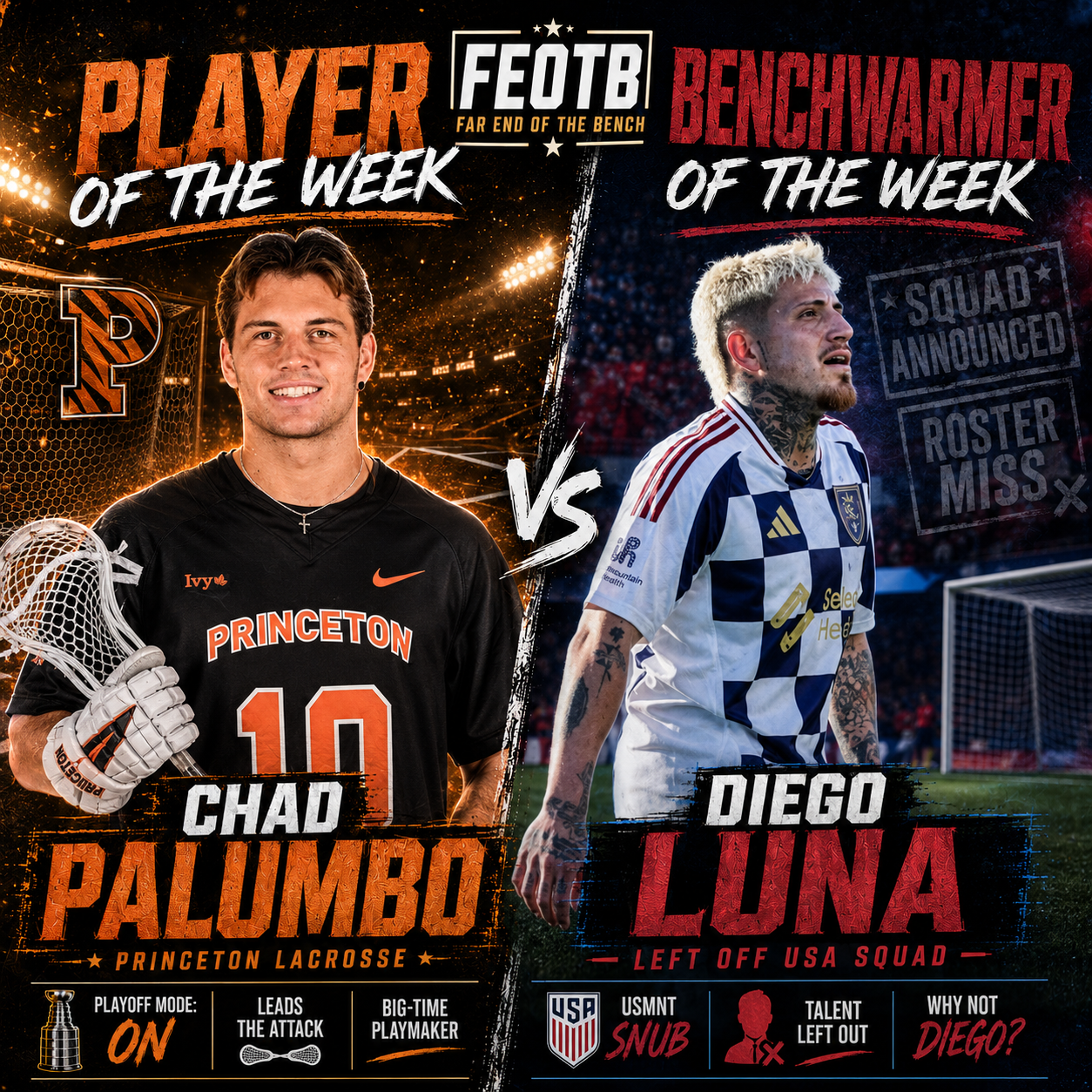
That is not just a roster gripe. That is a messaging problem.
On Jimmy’s side, Mark Stone embodied everything Vegas was in this series: composed, physical, timely, and built for playoff hockey. Nathan MacKinnon, meanwhile, became the face of the Avalanche collapse — not because he alone caused it, but because a player that great should not be standing at the end of a season wondering how this much talent only turned into this much disappointment.
That is the whole episode in one image.
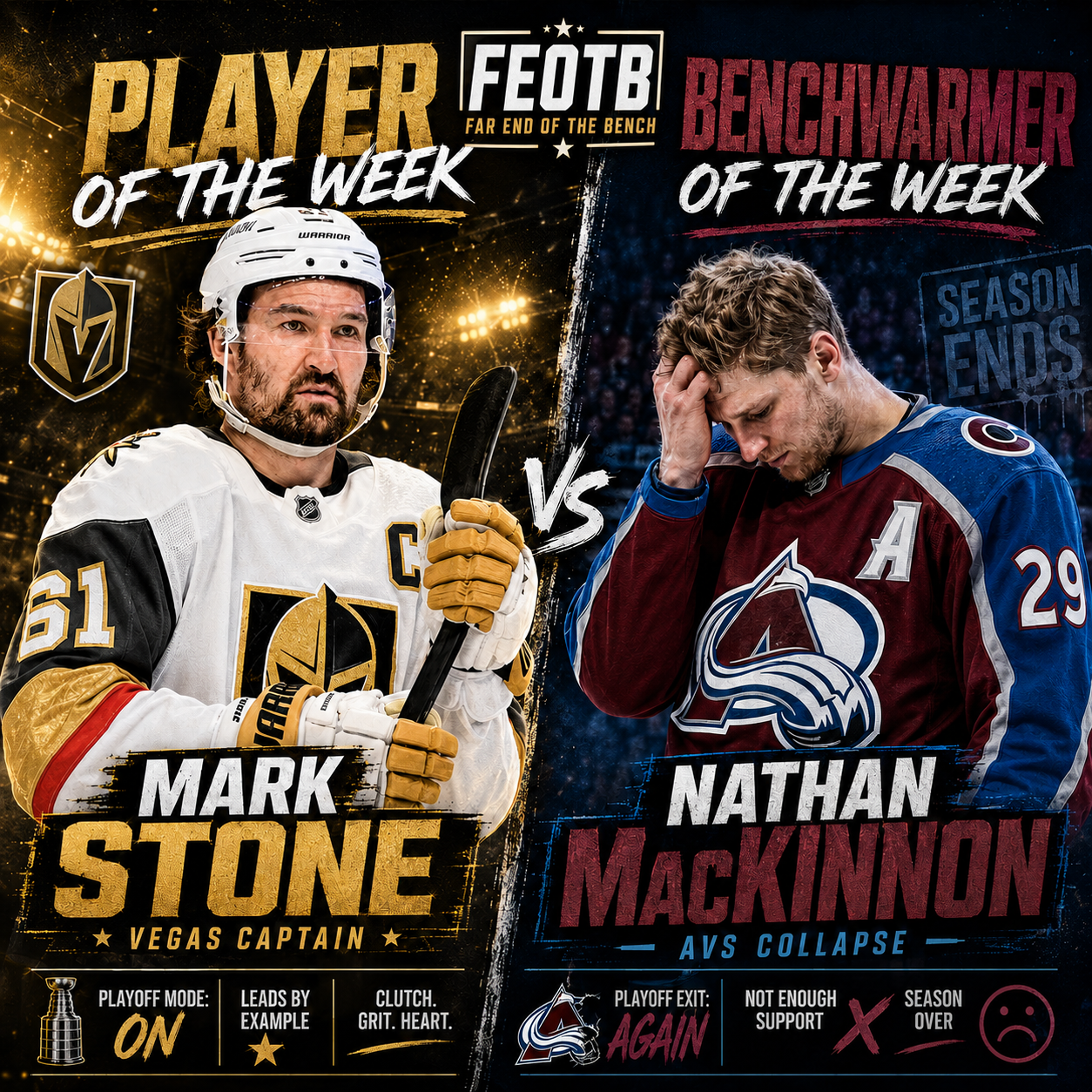
Vegas captain on one side. Avalanche superstar on the other. One team still playing. One team trying to explain how the season ended so fast.
Final Thought: Denver Sports Is Down Bad Right Now
Episode 276 really comes down to this: Denver sports fans are in a rough place.
The Avalanche are done. The Nuggets have their own scars. The Broncos pain never really leaves the room. And every time it feels like one team is ready to lift the city back up, another one finds a creative way to rip the floor out.
Is there a curse on Denver sports?
Maybe not.
But it sure feels like the sports gods have been reading from the same ugly script lately.
Still, that is why we do the show. We sit at the far end of the bench and talk it out. We laugh when it hurts. We argue when it gets messy. We give flowers when they are deserved and hand out benchwarmer nominations when somebody earns the seat.
Vegas buried the Avs.
The Knicks took New York.
Wemby is looming.
And Episode 276 had a little bit of everything that makes sports brutal, beautiful, and impossible to quit.
Watch/listen to Episode 276 of The Far End of the Bench: “Vegas Buries the Avs, Knicks Take New York & Wemby Looms.”

Co-Host
Jimmy Pallotto - Co-Host, The Far End of the Bench
Born and raised in the heart of Colorado, Jimmy Pallotto is the passionate voice behind The Far End of the Bench. A lifelong sports enthusiast, Jimmy brings unparalleled energy, humor, and insight to the podcast, combining his deep-rooted love for the game with a sharp analytical edge. As a proud alumnus of Western Colorado University, where he majored in Communication Arts and Sociology, Jimmy’s background equips him to deliver thoughtful commentary and engage in meaningful discussions with fans and guests alike.
Jimmy’s love for sports extends beyond the mic. By day, he’s shaping young minds as a 7th-grade social studies teacher and multi-sport coach, mentoring athletes in wrestling and football. A dedicated coach and educator, Jimmy instills the same values of teamwork, leadership, and dedication in his students that he shares on the podcast.
When he's not in the classroom or recording episodes, Jimmy enjoys spending time with his girlfriend Carlye, their energetic Border Collie Boomer, and his close-knit family. Whether he's breaking down game-winning plays, sharing hilarious locker room stories, or diving deep into the latest sports controversies, Jimmy’s vibrant personality and authentic voice make him a fan favorite.
Catch Jimmy every week on The Far End of the Bench, where he and his co-host Niko Bryant tackle everything from Colorado sports to national headlines, bringing the sidelines to center stage.
THE MORNING AFTER — WEEK 6: Texas Stunned, Georgia Takes the Throne & Oregon Implodes